


The Complete History of Magic Mushrooms
The Ancient Roots of Psilocybin Use: A Deep Dive into Human History of Magic Mushrooms
The human link to psilocybin is not new. This intimate partnership stretches back to prehistory. Tracing its lineage means consulting records written in stone. It also means studying preserved ceremonial practices.
Early Anthropological and Archaeological Evidence
Anthropologists found compelling evidence. Magic mushroom use dates back thousands of years. These clues appear in unexpected places.
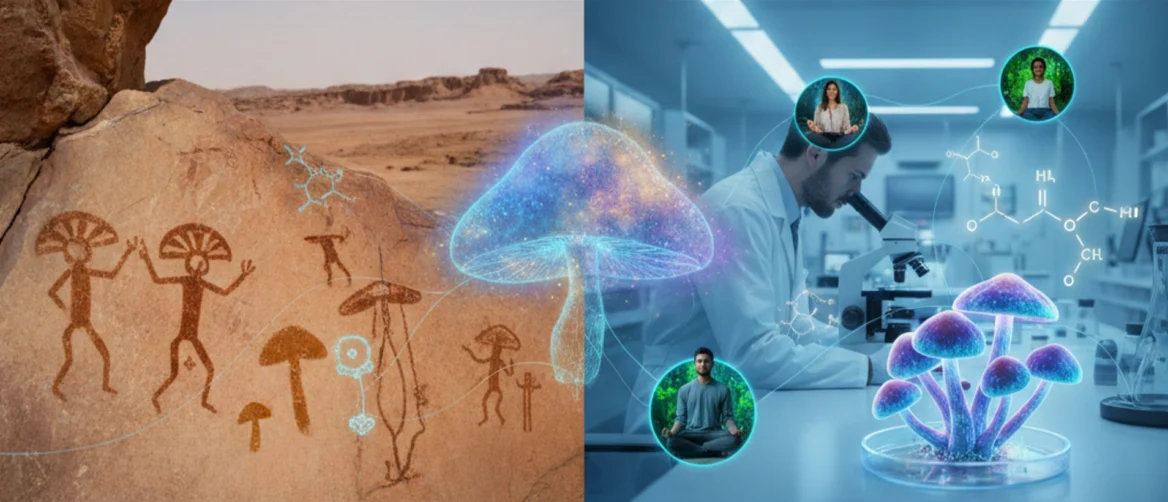
The most famous evidence comes from Tassili n’Ajjer. This is a plateau in the Sahara Desert, Algeria. Rock art from 7,000 to 9,000 years ago depicts the “Fungus Man.” Masked figures dance in this mural. Importantly, mushrooms sprout from one figure’s body. This scene suggests a shamanic ritual. The fungi’s details point to a Psilocybe species.
Similarly, we find Mesoamerican “mushroom stones.” They date back to 1000 B.C. These sculpted effigies have a stalk and cap. They were clearly used in ritual settings. Consequently, they symbolize ancient psychoactive fungi.
Prehistoric Spiritual and Shamanic Practices
For early societies, these fungi were not recreational. They served as vital spiritual tools. They shaped cosmology and social structure.
The primary use was as a shamanic conduit. Shamans were spiritual leaders. They ingested mushrooms to induce an altered state. They sought guidance and prophecy. Furthermore, they diagnosed and cured illnesses.
These practices built the foundation for later traditions. The Aztecs called the fungi Teonanácatl. This translates to “flesh of the gods.” This name confirms the mushrooms’ divine status. They were a direct embodiment of the cosmos.
Indigenous Cultures and Sacred Mushroom Rituals
The deepest use of psilocybin is found in indigenous cultures. Here, the fungi are treated as a powerful sacrament. These traditions represent sophisticated, tested spiritual systems.
Mesoamerican Civilizations and the Divine Flesh
The history of psilocybin is linked to Mesoamerica. Ritual use there was highly formalized.
The Aztecs revered Teonanácatl. The name means “Flesh of the Gods.” Use was restricted to priests and shamans. They used the fungi for prophecy and healing. The Florentine Codex confirms this. It shows mushroom use in sacred Aztec contexts.
Following the Spanish conquest, Catholicism suppressed the practice. Friars viewed mushroom use as idolatry. They associated it with the Devil. Colonial authorities outlawed ceremonies. Therefore, the practices were forced underground.
The Enduring Mazatec Tradition and the Velada
The most intact lineage comes from the Mazatec people. They live in Oaxaca, Mexico.
The core practice is the velada. This is an all-night healing vigil. A curandera (healer) performs the ritual. The mushrooms are viewed as “wise children.” They are consumed in darkness and silence. The healer guides participants with chants.
María Sabina was a famous curandera. She exposed the traditions in the 1950s. This exposure unfortunately caused global attention. However, it also cemented the Mazatec tradition’s legacy. It remains a powerful example of sacred use.
Colonial Suppression and Cultural Disruption
European arrival in the 16th century ruptured this sacred history. Indigenous spirituality clashed with European orthodoxy. This led to centuries of severe suppression.
The Spanish Conquest and Religious Eradication
The Spanish conquest was a religious campaign. It aimed to replace indigenous beliefs.
Spanish friars considered the ceremonies heretical. They viewed the visions as pacts with the Devil. Authorities implemented the “extirpation of idolatry.” They burned codices and sacred artifacts. All mushroom ceremonies were outlawed. Punishment for participants was severe. This was necessary to impose Catholic doctrine.
Loss of Knowledge and the Veil of Secrecy
The colonial effort successfully shut down public mushroom tradition. It forced the practice into deep secrecy.
Many traditions were entirely lost. Thankfully, ceremonies survived in remote mountain regions. Groups like the Mazatec maintained their heritage. They ensured a fragile, unbroken link. Knowledge transmission became highly restricted. This cultural firewall protected the traditions. Yet, it also made the history of magic mushrooms disappear publicly. Western science was cut off for 400 years.
Rediscovery in the 20th Century
The centuries-long veil of secrecy was lifted quickly. This happened in the mid-20th century. Anthropology and chemistry converged. They ignited the modern psychedelic era.
R. Gordon Wasson and the Cultural Revelation
R. Gordon Wasson reintroduced the mushroom to the West. He was a banker and an ethnomycologist.
In 1955, Wasson met María Sabina. He was the first Westerner to join a velada. He published his account in Life Magazine. The 1957 article was titled “Seeking the Magic Mushroom.” It introduced psilocybin to millions.
This publication was a double-edged sword. It preserved knowledge for the world. Nevertheless, it led to disruptive “psychedelic tourism.” It tragically brought persecution to María Sabina.
Albert Hofmann and the Scientific Blueprint
The scientific breakthrough followed quickly. Albert Hofmann was a Swiss chemist. He was famous for discovering LSD.
In 1958, Hofmann received mushroom samples. He successfully isolated the structures. These were psilocybin and psilocin. This was a crucial scientific step. Researchers could now use chemically pure, standardized doses. Sandoz sold the synthetic compound as Indocybin. This formal achievement launched modern psychedelic research.
The Psychedelic Boom and the Curtain of Prohibition (1960s)
Psilocybin and LSD were legal early in the 1960s. They were used extensively in clinics. This period began the First Wave of Research.
Academic Exploration and the Harvard Psilocybin Project
Thousands of studies investigated psychedelics. They looked at alcoholism and anxiety. Results often suggested fast breakthroughs.
As we discuss the history of magic mushrooms, the most famous program was at Harvard. Timothy Leary and Richard Alpert led it. Their research became highly controversial. Leary advocated for recreational use publicly. He urged people to “Turn on, tune in, drop out.” This advocacy resulted in their dismissal.
Psilocybin as a Countercultural Catalyst
Use quickly spread beyond the lab. Psilocybin became a countercultural symbol. It represented anti-establishment dissent. Furthermore, it symbolized spiritual liberation.
The altered state influenced the arts. Music and visual art became psychedelic. Psilocybin became the muse of the “Summer of Love.”
Government Backlash and Formal Criminalization
The rapid spread caused a large political reaction. Sensationalist media reports fueled a moral panic.
The government passed the Controlled Substances Act in 1970. Psilocybin was designated a Schedule I substance. This category claims high abuse potential. Crucially, it claims no medical use. Consequently, the act halted all research for decades.
The Quiet Period: Survival in the Scientific and Cultural Underground (1970s–1990s)
Scientific research fell into hibernation. However, the compound’s influence survived. It retreated into the cultural underground.
Underground Continuity and the Psychedelic Ethos
Legal restrictions were strict. Despite this, dedicated individuals continued the work.
Some therapists continued private, underground psychotherapy. They preserved the clinical knowledge. Furthermore, home cultivation techniques spread widely. This gave people democratic access to the fungi. Figures like Terence McKenna kept the conversation alive. McKenna popularized the Stoned Ape Theory. His philosophy inspired a new generation in the history of magic mushrooms.
Early Signs of the Scientific Thaw in the History of Magic Mushrooms
Academic interest began a slow, cautious return. Scientists argued that the ban was blocking inquiry.
By the late 1990s, the first studies were approved. These initial trials focused on safety. They looked at using psilocybin for OCD and cancer anxiety. These rigorously controlled tests provided crucial data. This evidence was necessary to convince regulators. It laid the foundation for the next boom.
The Modern Psychedelic Renaissance
This movement has shifted psilocybin’s status. It is now a promising area of mental health research.
The Trajectory of Clinical Psychedelic Medicine
Today’s renaissance is led by elite centers. These include Johns Hopkins and Imperial College London. They produce peer-reviewed data. They focus on Psilocybin-Assisted Therapy (PAT). This pairs the drug with extensive therapy.
With compounds in Phase 3 clinical trials, approval is near. Experts anticipate FDA approval in the late 2020s. This will make PAT a prescribed medicine. The future clinic model will be highly structured. It emphasizes preparation and integration.
Re-embracing Spirituality and Personal Growth
Psilocybin often causes feelings of awe. It also promotes mystical experiences.
Regulated access could address existential distress. It may promote psychological flexibility. Oregon and Colorado are pioneering this. They established regulated wellness models. This honors the ancient intentional use.
The Critical Challenges Ahead
The transition requires ethical stewardship. Several complex hurdles remain.
Commercialization is a major concern. Venture capital funds the research. Companies are patenting therapeutic protocols. This risks prioritizing profit over patient needs. Similarly, equitable access is challenging. High costs may limit the medicine to the wealthy. Furthermore, we must address biopiracy. We must ensure reciprocity for indigenous communities. Ethical practice and standardized training for facilitators are vital.
Conclusion of the History of Magic Mushrooms
The history of magic mushrooms reflects an extraordinary timeline—from ancient sacred rituals to modern therapeutic breakthroughs. As science continues to validate what indigenous cultures have known for millennia, psilocybin stands at the intersection of healing, spirituality, and human transformation. Understanding its past allows us to approach its future with respect, responsibility, and curiosity.
Where can I purchase psilocybin mushrooms?
Mindwell Mushrooms offers a variety of psilocybin mushrooms in various forms for your individual needs that include:
[...]


