


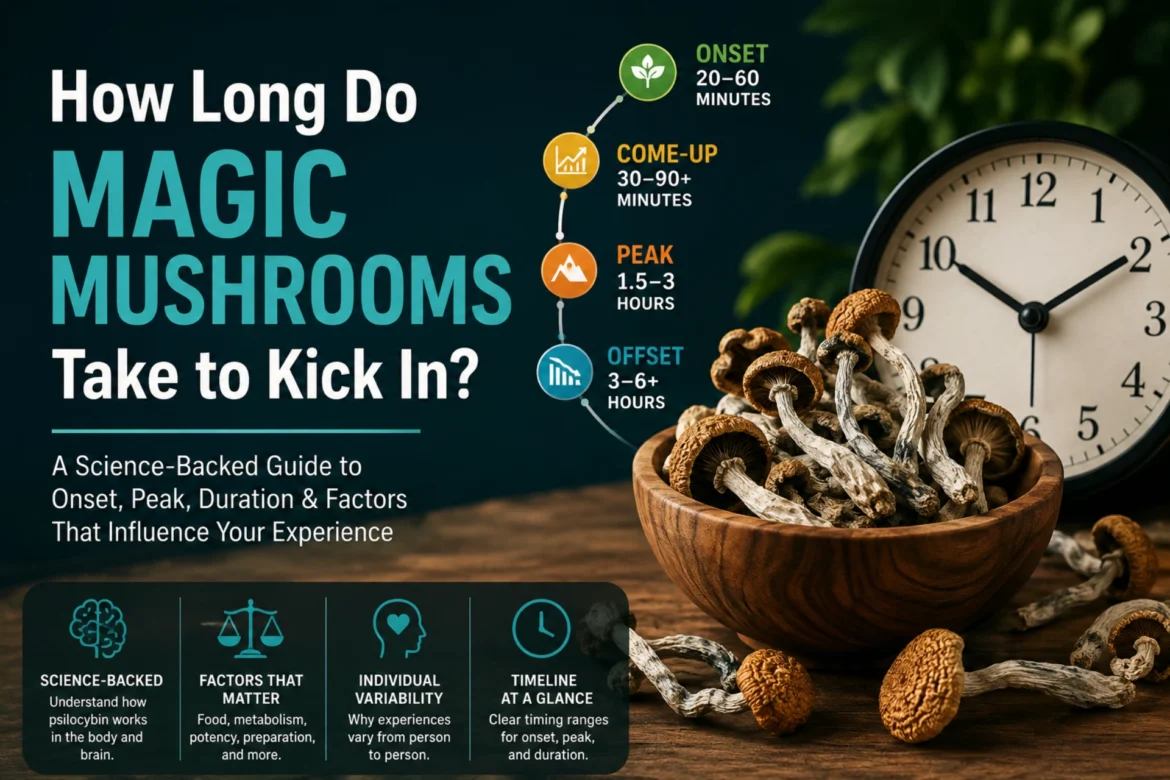
Magic mushrooms contain naturally occurring psychedelic compounds called psilocybin and psilocin. After consumption, the body converts psilocybin into psilocin, which interacts primarily with serotonin receptors in the brain. This process takes time, which is why the effects of magic mushrooms do not usually begin immediately.
How long magic mushrooms take to kick in can vary considerably from person to person. The method of consumption, whether food has recently been eaten, mushroom potency, individual metabolism, and other biological factors may all influence the onset and overall timeline of effects.
It is also important to distinguish between onset, peak effects, and total duration. The first noticeable changes represent the onset, while the strongest effects generally occur later. After the peak has passed, effects typically decrease gradually rather than ending suddenly.
Understanding these stages provides a more useful picture of the psilocybin experience than focusing on a single number. This guide examines what current research and clinical observations tell us about psilocybin onset, peak effects, overall duration, and the factors that can influence the timeline.
How Long Do Magic Mushrooms Take to Kick In?
The effects of psilocybin mushrooms commonly begin within approximately 20 to 60 minutes after oral consumption, although onset can occur earlier or later. Factors such as digestion, preparation method, individual metabolism, mushroom potency, and whether food has recently been consumed can influence how quickly effects become noticeable.
This range should be understood as a general reference rather than a precise prediction. Naturally occurring mushrooms vary in potency, and individual responses to psilocybin can also differ.
Understanding the Psilocybin Timeline
For clarity, it helps to think about the experience as several overlapping stages:
Onset: The period when the first effects begin to become noticeable.
Come-up: The transitional period as the effects gradually become more pronounced.
Peak: The period when the effects are generally strongest.
Offset: The gradual reduction in effects following the peak.
After-effects: Subtle changes in mood, energy, or perception that some people report after the primary effects have subsided.
These stages do not occur according to an exact timetable, and their duration can differ considerably between individuals.
Why the Timeline Can Vary
Psilocybin mushrooms are natural organisms rather than standardized pharmaceutical products. Their concentrations of psilocybin and psilocin can vary between species, strains, individual mushrooms, and even different parts of the same mushroom.
The person consuming them introduces another layer of variability. Digestion, metabolism, individual sensitivity, medications, recent food intake, and other physiological factors may influence when effects begin and how long they persist.
This is why discussions about psilocybin onset time are most accurate when presented as ranges rather than exact predictions.
Key Point to Understand
Magic mushrooms do not follow one universal timeline. Effects commonly begin within roughly 20 to 60 minutes, but onset, peak intensity, and total duration can vary based on the mushrooms themselves, preparation and consumption factors, and individual biology.
What Happens During the Onset?
The onset of psilocybin effects is the transitional period between consuming psilocybin mushrooms and beginning to notice changes in perception, mood, thinking, or physical sensations. These effects generally develop gradually as psilocybin is absorbed and converted into its active form, psilocin.
The timing and character of this period can vary considerably. Rather than functioning like an on/off switch, the effects typically become noticeable progressively as psilocin concentrations increase and interact with receptors in the brain.
Psilocybin Is Converted Into Psilocin
Psilocybin itself acts primarily as a prodrug, meaning the body converts it into another compound responsible for most of its psychoactive effects.
After ingestion, psilocybin is converted into psilocin through a process known as dephosphorylation. Psilocin then enters the bloodstream and can cross the blood-brain barrier.
Because absorption and metabolism take time, there is naturally a delay between consumption and the first noticeable effects.
Psilocin and Serotonin Receptors
Once psilocin reaches the brain, it interacts with several types of serotonin receptors, particularly the 5-HT2A receptor.
These receptors are found in brain regions involved in:
- Sensory processing
- Mood
- Cognition
- Attention
- Perception
- Emotional processing
Activation of 5-HT2A receptors is considered one of the primary mechanisms responsible for the characteristic effects associated with psilocybin.
What Early Effects May Feel Like
During onset, changes may initially be subtle and can differ significantly between individuals. Reported early effects can include changes in:
- Sensory awareness
- Emotional state
- Thought patterns
- Perception of time
- Physical sensations
- Visual perception
Some people also report temporary physical effects such as nausea or gastrointestinal discomfort during this period.
The presence or absence of any particular effect does not provide a reliable way to determine how intense the later experience will become.
The Come-Up Period
As more psilocin becomes available in the body, the onset gradually transitions into what is commonly called the come-up.
During this stage, perceptual and psychological effects may become increasingly noticeable before eventually approaching their strongest period.
Importantly, the come-up is not the same as the peak. The fact that initial effects have appeared does not mean the full intensity or duration of the experience has been reached.
This distinction is particularly useful when understanding the overall psilocybin timeline.
Why Onset Doesn’t Occur at an Exact Time
Even though a general onset range can be described, several biological variables influence absorption and metabolism.
These include:
- Digestive activity
- Recent food intake
- Individual metabolism
- Mushroom potency
- Preparation method
- Physiological differences between individuals
This variability explains why two people consuming similar mushroom material may notice effects at different times.
Key Point to Understand
The onset of magic mushroom effects begins as the body converts psilocybin into psilocin, which then interacts with serotonin receptors in the brain. Effects usually emerge progressively rather than instantaneously, and the timing can vary because absorption, metabolism, mushroom potency, and individual biology are not identical from one situation to another.
When Do Magic Mushroom Effects Typically Peak?
After the onset and come-up periods, psilocybin effects generally progress toward a peak, the stage when perceptual, emotional, and cognitive effects are typically at their strongest. The peak does not occur immediately when the first effects become noticeable, which is why distinguishing onset from peak timing is important when understanding the overall psilocybin timeline.
For orally consumed psilocybin mushrooms, peak effects are often reported approximately 1.5 to 3 hours after consumption, although the timing can vary. Research using measured psilocybin has similarly demonstrated that the intensity of effects develops over time rather than reaching its maximum immediately after administration.
What Does “Peak” Mean?
The peak refers to the portion of the experience when the overall effects are generally most pronounced.
Depending on the individual and the amount of active compounds involved, this period may include stronger changes in:
- Visual perception
- Sensory processing
- Emotional intensity
- Thought patterns
- Perception of time
- Self-awareness
- Communication between different brain networks
Not every effect necessarily reaches its maximum at exactly the same moment. Psychedelic experiences are dynamic, and different psychological or perceptual effects may increase and decrease throughout the peak period.
Why Peak Timing Can Vary
Just as there is no exact onset time, there is no universal time when psilocybin effects will peak.
Several factors can influence the timeline, including:
- Individual metabolism
- Digestive activity
- Recent food intake
- Mushroom potency
- Preparation and consumption method
- Individual sensitivity
- The concentration of active compounds
Because naturally occurring mushrooms are biologically variable, two samples of the same weight do not necessarily contain identical amounts of psilocybin and psilocin.
This is one reason mushroom potency remains important when interpreting descriptions of onset, intensity, and duration.
What Happens in the Brain During Peak Effects?
During the period of strongest effects, psilocin continues interacting primarily with 5-HT2A serotonin receptors and influencing communication across multiple brain networks.
Brain-imaging research has observed temporary changes in connectivity between regions that normally communicate less extensively, along with changes involving networks such as the Default Mode Network (DMN).
These findings have become an important part of modern research into how psilocybin affects perception, cognition, and brain function.
Does a Faster Onset Mean an Earlier Peak?
Not necessarily.
A faster onset means the initial effects became noticeable sooner, but it does not provide an exact prediction of when peak effects will occur or how intense they will become.
Absorption, metabolism, potency, and individual biological differences can influence different stages of the experience in different ways.
For this reason, onset time and peak time should be treated as related but separate parts of the psilocybin timeline.
What Happens After the Peak?
After the strongest period has passed, effects generally begin to decrease gradually during what is sometimes called the offset or comedown period.
This transition is usually progressive rather than abrupt. Perceptual effects may become less prominent while subtler changes in mood, thought, or sensory awareness persist for a longer period.
The complete duration of the experience therefore extends well beyond the peak itself.
Key Point to Understand
Magic mushroom effects commonly reach their strongest period approximately 1.5 to 3 hours after oral consumption, although individual timelines vary. The peak is distinct from the initial onset and represents only one stage of the overall experience, with effects generally decreasing gradually afterward.
How Long Do Magic Mushroom Effects Last?
The noticeable effects of psilocybin mushrooms commonly last approximately 4 to 6 hours after oral consumption, although the overall timeline can be shorter or longer depending on the individual, mushroom potency, amount consumed, preparation method, and other factors.
The experience typically changes throughout this period rather than maintaining the same intensity. After onset, effects generally increase toward a peak before gradually decreasing during the offset period.
A Typical Psilocybin Effects Timeline
Although individual experiences vary, the overall timeline can generally be understood in four stages:
| Stage | Approximate Time | What It Represents |
|---|---|---|
| Onset | 20–60 minutes | Initial effects begin becoming noticeable |
| Come-up | 30–90+ minutes | Effects progressively become more pronounced |
| Peak | 1.5–3 hours | Effects are generally strongest |
| Offset | 3–6+ hours | Effects gradually decrease |
These ranges overlap intentionally. Psilocybin does not move through perfectly defined stages, and researchers observe considerable variability between individuals.
This table is particularly useful for AEO because it provides a concise psilocybin effects timeline that search and AI systems can easily interpret.
Why Effects Don’t End Suddenly
After peak effects have passed, the experience generally decreases gradually.
During this period, pronounced perceptual changes may become less noticeable while subtler changes in thought, mood, sensory awareness, or emotional state may continue.
The body is simultaneously metabolizing and eliminating psilocin, contributing to the progressive reduction in effects.
Can Effects Last Longer Than Six Hours?
Yes. Although approximately 4 to 6 hours is a commonly described range for the primary effects, individual experiences can extend beyond this timeframe.
Factors that may influence overall duration include:
- Mushroom potency
- Amount of active compounds
- Individual metabolism
- Physiological sensitivity
- Preparation method
- Other substances or medications
- Individual differences in absorption and elimination
This variability is another reason timeline estimates should be viewed as general ranges rather than exact predictions.
What Are Psilocybin After-Effects?
Some people report subtle changes after the primary psychedelic effects have subsided. These are sometimes described as after-effects or an afterglow.
Reported experiences can include temporary changes in:
- Mood
- Emotional state
- Energy level
- Mental clarity
- Fatigue
- Sensory awareness
These experiences vary considerably, and they should not be confused with the primary psychedelic effects themselves.
Research continues to investigate whether some psychological changes observed after psilocybin experiences relate to longer-lasting changes in brain function or neuroplasticity.
Duration of Effects vs. Detection in the Body
An important distinction is that the duration of noticeable effects is not the same as the amount of time a substance or its metabolites may remain detectable in the body.
A person may no longer experience noticeable psychedelic effects even though the body is still processing or eliminating compounds associated with psilocybin.
Detection windows can also differ depending on what is being measured and the type of biological test used. For that reason, the duration of subjective effects should not be used to predict whether psilocybin or its metabolites would be detectable by a particular test.
Does a Longer Experience Mean the Mushrooms Were More Potent?
Not necessarily.
Potency can influence the intensity and potentially the duration of an experience, but duration alone is not a reliable measurement of mushroom potency.
Individual metabolism, digestion, preparation, active-compound concentration, and biological sensitivity can all influence the timeline.
This is why potency and duration are related concepts but should not be treated as interchangeable measurements.
Key Point to Understand
The primary effects of magic mushrooms commonly last approximately 4 to 6 hours, with onset occurring earlier, followed by a peak and gradual offset. Some effects or after-effects may persist longer, and individual timelines can vary considerably.
What Factors Can Affect How Long Magic Mushrooms Take to Kick In?
Although magic mushroom effects commonly begin within about 20 to 60 minutes, onset time can vary considerably. Psilocybin must first be absorbed and converted into psilocin, and several biological and consumption-related factors can influence how quickly that process occurs.
This is why an onset range is more useful than expecting effects to begin at one specific time.
Recent Food Intake
Food in the digestive system may influence how quickly orally consumed substances are absorbed.
A recent or substantial meal can slow gastric emptying, potentially delaying the movement of mushroom material through the digestive system. However, digestion varies considerably between individuals, so food intake alone cannot reliably predict exactly when effects will begin.
Food may also influence gastrointestinal experiences such as nausea, making the relationship between eating and psilocybin onset more complex than simply “faster” or “slower.”
Individual Metabolism
Metabolism plays an important role in how the body processes psilocybin and psilocin.
Factors such as genetics, age, liver function, digestive activity, and individual physiology may contribute to differences in absorption and metabolism. Two people consuming similar mushroom material under similar circumstances therefore may not experience identical timelines.
This biological variability is one reason research studies often report ranges rather than precise onset times.
Mushroom Potency
Psilocybin mushrooms are naturally variable biological organisms. The concentration of active compounds can differ between:
- Species
- Strains or cultivated varieties
- Individual mushrooms
- Growing conditions
- Harvests
- Storage conditions
Even mushrooms that appear similar may not contain identical concentrations of psilocybin and psilocin.
Because of this variability, mushroom potency can influence the overall experience and may contribute to differences in how noticeable the initial effects are.
Species and Strain
Different species of psilocybin-containing mushrooms can have substantially different concentrations of active compounds.
Variation may also occur among cultivated varieties commonly described as strains. However, strain names alone should not be treated as precise measurements of potency because growing conditions, genetics, harvesting, drying, and storage can all affect the final concentration of active compounds.
Storage Conditions
How mushrooms are stored can influence their chemical stability over time.
Exposure to factors such as:
- Moisture
- Heat
- Oxygen
- Light
may contribute to degradation of active compounds. Storage conditions therefore matter when discussing potency, particularly with mushroom material that has been stored for extended periods.
Preparation and Consumption Method
The physical form in which mushroom material is consumed can affect digestion and absorption.
Different preparation methods may alter how quickly mushroom material reaches the digestive system or how readily active compounds become available for absorption.
This is one reason onset times reported for whole dried mushrooms may differ from those reported for other preparations.
We’ll examine this factor separately in the next section because it deserves more context.
Medications and Other Substances
Some medications and substances can influence serotonin signaling, metabolism, or subjective responses to psilocybin.
Researchers are particularly interested in potential interactions involving psychiatric medications that affect the serotonin system. However, these relationships can be complex and should not be reduced to simple predictions about whether effects will begin sooner or later.
Medication changes should be discussed with a qualified healthcare professional rather than made for the purpose of altering a psychedelic experience.
Individual Sensitivity
People can differ substantially in their sensitivity to psychoactive substances.
Individual biology, previous experiences, psychological state, and other factors may influence how quickly subtle changes become noticeable. This means that two people could potentially begin noticing effects at different times even when other variables appear similar.
Why Onset Time Doesn’t Predict Intensity
A particularly important misconception is that a fast onset automatically means a stronger experience—or that a slow onset means the mushrooms are weak.
Neither conclusion is reliable.
Onset describes when effects begin, while intensity describes how pronounced those effects become. Although both can be influenced by some of the same variables, one does not reliably predict the other.
Key Point to Understand
How long magic mushrooms take to kick in can be influenced by food intake, digestion, metabolism, mushroom potency, species, storage, preparation method, medications, and individual sensitivity. Because these variables interact differently from person to person, onset times are best understood as approximate ranges rather than exact predictions.
Does the Method of Consumption Affect Onset?
The way psilocybin mushrooms are consumed may influence how quickly their effects become noticeable. Different preparations can change how much physical mushroom material must be digested and how readily active compounds become available for absorption.
However, preparation method is only one factor. Potency, recent food intake, metabolism, digestion, and individual sensitivity can still produce substantial differences in onset time.
Whole or Dried Mushrooms
Eating whole dried mushrooms requires the digestive system to break down the mushroom material before and during absorption of its active compounds.
This is one reason effects from orally consumed dried mushrooms are commonly described as beginning within approximately 20 to 60 minutes, although individual timelines may fall outside that range.
The physical structure of the mushroom, digestive activity, and recent food intake can all contribute to variation.
Mushroom Tea
Mushroom tea is another commonly discussed preparation. Because some of the active compounds may already be present in the liquid rather than contained entirely within intact mushroom material, effects are sometimes reported as beginning sooner than when whole mushrooms are eaten.
However, there is no exact onset time that applies to mushroom tea. Preparation differences and individual physiology make direct comparisons difficult.
Lemon Tek
Lemon Tek is a preparation method in which mushroom material is exposed to acidic citrus juice before consumption. It is commonly associated with anecdotal reports of a faster onset and a more compressed overall experience.
One popular explanation is that acidity somehow converts psilocybin into psilocin before consumption. That explanation is frequently repeated online, but the underlying chemistry is more complicated, and strong clinical evidence demonstrating that lemon juice reliably performs this conversion before ingestion is lacking.
A faster reported onset could also involve extraction of active compounds into liquid, the physical preparation of the mushroom material, digestion, or a combination of factors.
For that reason, claims about Lemon Tek should be distinguished from established pharmacological evidence.
Mushrooms Consumed With Food
Psilocybin mushrooms may also be incorporated into food or eaten alongside a meal.
Because food can affect gastric emptying and digestion, this may influence when active compounds are absorbed. The composition and size of the meal, as well as individual digestive differences, can contribute to the resulting timeline.
This makes it difficult to assign a single onset range to mushroom-containing foods.
Why Liquid Preparations May Feel Different
Reports of faster onset with certain liquid preparations are biologically plausible because liquids and extracted compounds can move through the digestive system differently from intact solid mushroom material.
That does not mean every liquid preparation will reliably produce faster effects.
The available evidence does not support using preparation method alone to predict an exact onset, peak, intensity, or duration.
Preparation Method and Potency Are Different
It’s also important not to confuse how quickly effects appear with how much active compound is present.
Preparation can potentially affect the rate at which compounds become available for absorption, whereas potency describes the concentration of active compounds in the mushroom material itself.
A faster onset therefore does not necessarily mean a preparation contains more psilocybin or will produce stronger overall effects.
Key Point to Understand
The method used to consume psilocybin mushrooms may influence onset because different preparations can affect digestion and absorption. Whole mushrooms, mushroom tea, food preparations, and Lemon Tek may therefore have different reported timelines, but research does not support an exact onset time for each method, and individual variability remains significant.
Why Psilocybin Effects Can Vary From Person to Person
Even when two people consume similar psilocybin-containing mushroom material, their experiences may differ considerably. The timing, intensity, emotional character, and subjective effects of psilocybin are influenced by more than the mushrooms themselves.
Researchers often distinguish between pharmacological factors—what the substance is doing within the body—and contextual factors, which can influence how those effects are experienced and interpreted.
This helps explain why a general psilocybin timeline can provide useful context but cannot precisely predict an individual’s experience.
Individual Biology
People absorb, metabolize, and eliminate substances at different rates. Genetics, digestive function, liver metabolism, age, physiology, and other biological differences may influence how psilocybin is processed.
Individual sensitivity to psilocin and serotonin receptor activity may also vary.
As a result, similar exposure does not necessarily produce identical effects or timelines between individuals.
Potency and Natural Variation
Psilocybin mushrooms are not chemically identical from one specimen to another.
Concentrations of psilocybin, psilocin, and other naturally occurring compounds may vary based on species, genetics, growing conditions, maturity, drying, and storage.
This natural variation makes comparisons based only on the physical amount of mushroom material less precise than comparisons involving standardized compounds in controlled research.
Mindset and Psychological State
Researchers studying psychedelics frequently consider set, or the psychological state someone brings into an experience.
Mood, expectations, stress levels, previous experiences, and emotional state may influence how psychedelic effects are perceived and interpreted.
Expectations are particularly important in psychedelic research because anticipating a certain effect can influence subjective reports. This is one reason placebo-controlled psychedelic studies can be challenging to design.
Environment and Setting
Setting refers to the physical and social environment surrounding a psychedelic experience.
Factors such as familiarity with the environment, sensory stimulation, social interactions, and feelings of comfort or uncertainty may influence the subjective character of an experience.
This does not necessarily mean that setting dramatically changes how quickly psilocybin is metabolized. Rather, it may influence how noticeable, meaningful, or intense particular effects feel.
Previous Psychedelic Exposure
Previous experiences with psychedelic substances may influence how someone recognizes and interprets early effects.
Someone familiar with psilocybin may identify subtle changes earlier, while someone unfamiliar with those sensations may not recognize them immediately.
That distinction is important because reported onset time partly depends on when a person first notices an effect, not solely on when psilocin begins interacting with receptors in the brain.
Medications and Health Factors
Medications that influence serotonin signaling or other neurological systems may affect responses to psilocybin. Underlying physical and mental health factors can also influence individual experiences and risk.
Because medication interactions can be complex, changes to prescription medication should only be made in consultation with a qualified healthcare professional.
Subjective Experience vs. Pharmacological Timeline
This distinction is particularly important for understanding psilocybin research.
The pharmacological timeline describes processes such as:
absorption → conversion to psilocin → receptor activity → metabolism → elimination
The subjective timeline describes when an individual notices and interprets psychological, perceptual, emotional, or physical effects.
The two are related, but they are not identical.
This helps explain why researchers can identify general pharmacological patterns while individual reports still vary substantially.
Key Point to Understand
Psilocybin effects vary from person to person because biology, mushroom potency, psychological state, environment, previous experience, medications, and individual sensitivity can all influence the experience. A general timeline can describe common patterns, but it cannot precisely predict when effects will begin, how intense they will become, or how an individual will experience them.
Common Misconceptions About Magic Mushroom Onset and Duration
Because psilocybin experiences can vary considerably, general timeline estimates are sometimes interpreted too rigidly. Onset, peak, intensity, and duration describe different aspects of an experience, and one does not necessarily predict another.
Understanding these distinctions can help separate commonly repeated assumptions from what research and pharmacology actually support.
Misconception: Magic Mushrooms Always Kick In Within 30 Minutes
Although some people notice effects within about 30 minutes, there is no universal onset time.
Orally consumed psilocybin mushrooms are commonly associated with an onset of approximately 20 to 60 minutes, but effects can begin earlier or later depending on digestion, recent food intake, preparation method, metabolism, potency, and individual biology.
A general range should therefore not be treated as a countdown.
Misconception: A Slow Onset Means the Mushrooms Aren’t Working
A delayed onset does not necessarily indicate that psilocybin is inactive or that the mushrooms have lost their potency.
Digestion and absorption can vary substantially, particularly when food has recently been consumed. Individual differences in metabolism and sensitivity may also affect when the first changes become noticeable.
Onset time alone therefore provides limited information about what may happen later.
Misconception: A Faster Onset Means Greater Potency
How quickly effects become noticeable and how much psilocybin a mushroom contains are different measurements.
A preparation that is absorbed more quickly could potentially produce an earlier onset without containing a greater concentration of active compounds. Conversely, potent mushroom material does not necessarily produce an unusually rapid onset.
Potency, onset, and intensity are related variables, but they are not interchangeable.
Misconception: The First Effects Are the Peak
Initial changes mark the onset, not the peak.
Effects generally continue developing during the come-up period before reaching their strongest stage. This distinction is why an onset of approximately 20 to 60 minutes and a peak around 1.5 to 3 hours describe different parts of the same overall timeline.
Misconception: Everyone Follows the Same 4-to-6-Hour Timeline
Approximately 4 to 6 hours is a useful general range for the primary effects, but it is not a guarantee.
Some experiences may be shorter or longer, and subtle after-effects may persist after the primary psychedelic effects have decreased. Individual biology, active-compound concentration, preparation, and other factors can all contribute to variation.
Misconception: Once the Effects End, Psilocybin Has Completely Left the Body
The disappearance of noticeable effects does not mean that every related compound or metabolite has immediately been eliminated.
Subjective effects and drug metabolism operate on related but different timelines. The body may continue processing and eliminating substances after pronounced psychological or perceptual effects have subsided.
This is also why duration of effects should not be used to predict drug-test detection windows.
Misconception: Lemon Tek Has Been Proven to Convert Psilocybin Into Psilocin Before Consumption
This explanation is commonly repeated online, but it is more definitive than the available evidence supports.
Acidic preparation may affect extraction and the physical characteristics of mushroom material, and Lemon Tek is frequently associated with anecdotal reports of faster onset. However, strong clinical evidence demonstrating that lemon juice reliably performs the body’s psilocybin-to-psilocin conversion before consumption is lacking.
That distinction is worth maintaining between a popular explanation and an established pharmacological mechanism.
Key Point to Understand
Magic mushroom onset and duration are best understood as ranges rather than exact deadlines. A slower onset does not necessarily indicate low potency, faster onset does not automatically mean greater intensity, and the first noticeable effects are not the same as the peak.
Frequently Asked Questions About Magic Mushroom Onset and Duration
Magic mushroom effects commonly begin approximately 20 to 60 minutes after oral consumption, although onset may occur earlier or later. Digestion, recent food intake, mushroom potency, preparation method, metabolism, and individual sensitivity can all influence when effects become noticeable.
Psilocybin must be absorbed and converted into psilocin, the compound responsible for most of its psychoactive effects. Noticeable effects commonly begin within about 20 to 60 minutes after oral consumption, but individual timelines vary.
Effects commonly reach their strongest period approximately 1.5 to 3 hours after consumption. The peak occurs after the initial onset and come-up, and its timing can vary based on individual biology and other factors.
The primary effects of psilocybin mushrooms commonly last approximately 4 to 6 hours. Some people may experience shorter or longer timelines, and subtle after-effects can persist after the primary effects have subsided.
Recent food intake may influence onset because food can affect gastric emptying, digestion, and absorption. A substantial meal may delay onset for some people, although individual digestive differences make it difficult to predict an exact timeframe.
Mushroom tea is sometimes reported to produce a faster onset than eating whole dried mushrooms, potentially because active compounds are already present in liquid rather than contained entirely within solid mushroom material. However, research does not establish an exact onset difference, and individual responses vary.
Lemon Tek is commonly associated with anecdotal reports of a faster onset and a more compressed experience. However, strong clinical evidence specifically evaluating Lemon Tek is limited, and the popular claim that lemon juice reliably converts psilocybin into psilocin before consumption has not been firmly established.
Differences in digestion, metabolism, recent food intake, preparation, mushroom potency, medications, and individual physiology can influence onset. The point at which someone recognizes subtle effects can also affect their reported onset time.
No. Onset and potency are different concepts. Onset describes how quickly effects become noticeable, while potency refers to the concentration of active compounds. A faster onset does not reliably predict greater potency or a more intense experience.
Yes. Although approximately 4 to 6 hours is a commonly described range for the primary effects, individual experiences can extend beyond six hours. Subtle after-effects may also continue after the primary psychedelic effects have diminished.
The duration of noticeable effects is different from the time psilocybin-related compounds or metabolites may remain detectable in the body. Detection depends on the biological sample, testing method, metabolism, and other variables, so the 4-to-6-hour effects timeline should not be treated as a detection window.
To Wrap This Article Up
Understanding the Magic Mushroom Effects Timeline
How long magic mushrooms take to kick in depends on several interacting factors, but research and clinical observations provide a useful general framework. Effects commonly begin approximately 20 to 60 minutes after oral consumption, often reach their strongest period around 1.5 to 3 hours, and typically continue for approximately 4 to 6 hours before gradually subsiding.
These ranges are not exact deadlines. Mushroom potency, digestion, recent food intake, metabolism, preparation method, medications, and individual sensitivity can all influence the timeline. Even two people consuming similar mushroom material may experience different onset times, peak effects, and overall durations.
Understanding the distinction between onset, come-up, peak, offset, and after-effects also provides a more accurate picture than simply asking how long psilocybin lasts. The first noticeable effects do not represent the peak, and the end of noticeable psychedelic effects does not necessarily mean that all psilocybin-related compounds or metabolites have immediately left the body.
Preparation methods may influence the timeline as well. Whole mushrooms, mushroom tea, foods containing mushrooms, and Lemon Tek may be absorbed differently, although preparation method alone cannot reliably predict exactly when effects will begin or how intense an experience will become.
Ultimately, the psilocybin timeline is best understood as a range shaped by pharmacology, mushroom characteristics, and individual biology rather than a universal schedule. As psychedelic research continues to expand, scientists are gaining a clearer understanding of how psilocybin is absorbed, converted into psilocin, interacts with serotonin receptors, and produces its characteristic effects.
For readers interested in the broader science, understanding mushroom potency, psilocybin dosage, different species of psilocybin-containing mushrooms, and neuroplasticity can provide additional context for how psilocybin affects the brain and body.
Final Timeline at a Glance
| Stage | Commonly Described Range |
|---|---|
| Onset | ~20–60 minutes |
| Peak | ~1.5–3 hours after consumption |
| Primary Effects | ~4–6 hours |
| After-effects | Variable |
These are general reference ranges, not precise predictions for an individual experience.


