


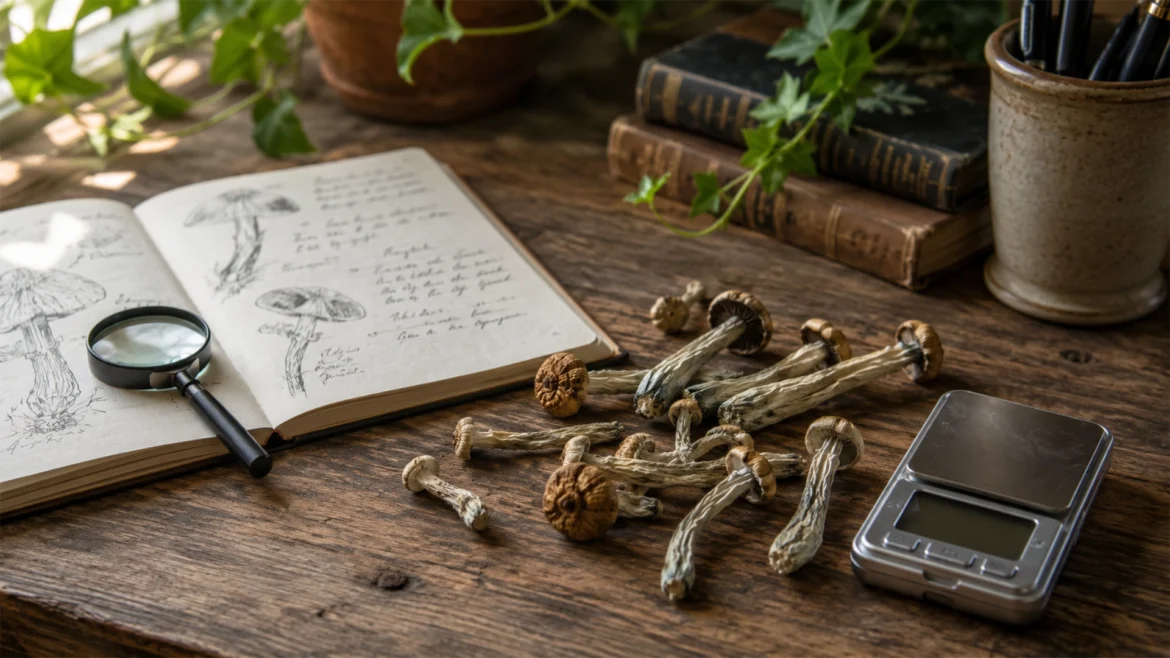
The amount of psilocybin someone experiences depends on more than just the number of mushrooms consumed. Magic mushroom dosage can vary based on the mushroom species, strain, potency, whether the mushrooms are fresh or dried, and individual factors such as body chemistry and personal sensitivity. Because of these variables, there is no single dosage that applies to everyone.
Educational resources often describe magic mushroom doses using general dosage ranges, such as beginner, moderate, and high doses. These categories help explain how experiences may differ as the amount of psilocybin increases, while recognizing that potency can vary naturally from one mushroom to another.
This guide explains how magic mushroom dosage is commonly categorized, the factors that influence potency, and why understanding mushroom strength is just as important as understanding the amount consumed. Rather than focusing on a specific number, the goal is to provide a clear educational overview of the concepts that influence dosage and the overall experience.
By the end of this article, readers will understand:
- How magic mushroom dosage is commonly classified
- Why potency can vary between mushroom species and strains
- The factors that influence how different dosage ranges are discussed
- Why mushroom strength is just as important as the amount consumed
What Is a Magic Mushroom Dosage?
Magic mushroom dosage refers to the amount of psilocybin-containing mushrooms consumed during a single experience. Dosage is commonly discussed in beginner, moderate, and high ranges, but the effects can vary depending on mushroom potency, strain, individual sensitivity, and whether the mushrooms are fresh or dried.
Understanding Magic Mushroom Dosage Ranges
Magic mushroom dosage is often described using general dosage ranges rather than exact recommendations. This is because the amount of psilocybin can vary naturally between different mushroom species, strains, and even individual mushrooms from the same harvest. As a result, two mushrooms that appear nearly identical may contain different amounts of the active compounds.
Educational resources and scientific studies commonly group magic mushroom doses into broad categories such as low, moderate, and high. These categories are intended to describe the relative amount of psilocybin consumed, not to predict a specific experience. Individual responses can vary based on many factors, including mushroom potency, personal physiology, environment, and previous experience.
Because of this variability, dosage ranges should be viewed as educational reference points rather than precise measurements. Understanding how potency, species, and storage conditions influence psilocybin content provides a more complete picture than focusing on weight alone.
Why Mushroom Weight Doesn’t Tell the Whole Story
Many people assume that weighing mushrooms provides a complete picture of dosage, but weight is only one part of the equation. Two equal-weight samples can differ in potency due to natural variations in psilocybin and psilocin concentrations.
Several factors influence the amount of active compounds present, including:
- The mushroom species
- The specific strain or genetic lineage
- Growing conditions
- Harvest timing
- Drying and storage methods
- Natural biological variation
This is why educational guides often discuss both mushroom weight and potency together rather than treating them as separate topics.
Potency Matters Just as Much as Quantity
A larger amount of a lower-potency mushroom does not necessarily produce the same effects as a smaller amount of a higher-potency variety. For example, some Psilocybe cubensis strains are known to contain higher average concentrations of psilocybin than others, while entirely different species may have their own typical potency ranges.
Understanding the relationship between dosage and potency helps explain why mushroom type is an important consideration when comparing experiences. Rather than assuming all mushrooms have the same strength, it is more accurate to think of dosage as a combination of the amount consumed and the concentration of active compounds.
Key Point to Understand
Magic mushroom dosage is best understood as the relationship between quantity and potency. While dosage ranges provide a useful educational framework, the overall experience is influenced by the mushroom’s natural psilocybin content, individual variability, and other factors that extend beyond weight alone.
How Magic Mushroom Dosage Ranges Are Commonly Described
Educational resources commonly group magic mushroom doses into broad categories based on the relative intensity of their effects rather than a universal amount. Because mushroom potency varies naturally, these categories are intended to provide a general framework for understanding the topic—not to predict how any individual experience will unfold.
Several factors can influence how a particular dosage range is experienced, including the mushroom species, strain, potency, whether the mushrooms are fresh or dried, and each person’s unique physiology.
Low Dosage Range
A low dosage range is generally described as producing milder effects than higher dosage ranges. Educational discussions often characterize this range as involving more subtle changes in perception and mood while allowing individuals to remain more aware of their surroundings.
Because potency differs between mushrooms, what is considered a low dose for one variety may not produce the same level of effects with another.
Moderate Dosage Range
A moderate dosage range is commonly described as producing more noticeable changes in perception, thought patterns, and sensory awareness. This range is frequently referenced in educational materials because it represents the point where the effects of psilocybin typically become more pronounced.
Even within this category, the overall experience can vary significantly depending on mushroom potency and individual sensitivity.
High Dosage Range
A high dosage range is generally associated with substantially stronger effects than lower ranges. Educational resources often describe this category as involving more significant changes in perception, awareness, and cognition.
Because potency can vary considerably between mushroom species and strains, educational guides consistently emphasize that higher dosage ranges require an understanding of the mushroom’s strength rather than relying on quantity alone.
Why There Are No Universal Dosage Categories
Although dosage ranges are widely discussed, there is no single standard that applies to every type of psilocybin mushroom. Two samples of the same weight may differ in potency because of natural biological variation, cultivation methods, storage conditions, and genetics.
This is why researchers and educators often recommend thinking about dosage in terms of both the amount consumed and the mushroom’s potency, rather than relying on weight alone.
Key Point to Understand
Magic mushroom dosage ranges provide a useful educational framework for understanding relative intensity, but they should not be viewed as fixed measurements. Potency, mushroom type, storage conditions, and individual variability all contribute to how a particular dosage range may be experienced.
Why Potency Is Just as Important as Dosage
When discussing magic mushroom dosage, potency is just as important as the amount consumed. Two mushrooms that weigh the same may contain different concentrations of psilocybin and psilocin, which means they can produce noticeably different effects.
This natural variability is one of the reasons educational resources avoid treating mushroom weight as the only measure of dosage. Instead, dosage is best understood as the relationship between quantity and potency.
Potency Varies Naturally
Psilocybin mushrooms are natural organisms, and like many naturally occurring products, their chemical composition can vary.
Several factors contribute to these differences, including:
- The mushroom species
- The specific strain or genetic lineage
- Growing conditions
- Harvest timing
- Drying methods
- Storage conditions
- Natural biological variation
Because of these factors, mushrooms that appear nearly identical can still differ in potency.
Species and Strains Make a Difference
Different species of psilocybin mushrooms are known for having different average potency ranges. Even within the same species, individual strains may produce higher or lower concentrations of psilocybin.
For example, many commonly cultivated mushrooms belong to Psilocybe cubensis, yet individual strains within this species are often recognized for differing average potency levels. Understanding these differences helps explain why mushroom type is frequently discussed alongside dosage.
Storage Can Influence Potency Over Time
Potency is not determined only at harvest. Environmental exposure after drying can also influence how well mushrooms retain their active compounds.
Factors such as:
- Moisture
- Heat
- Oxygen
- Light
can gradually contribute to the natural breakdown of psilocybin over time.
Proper storage helps preserve mushroom quality and may slow this process.
Potency Is More Than a Number
Potency is often discussed as though it can be measured by a single value, but in reality it reflects a combination of biological and environmental factors. While laboratory testing can measure the concentration of active compounds in a specific sample, naturally occurring variation means that no two mushrooms are guaranteed to be identical.
Understanding potency as a spectrum rather than a fixed value provides a more accurate way to compare mushroom types and interpret educational dosage information.
Key Point to Understand
Dosage and potency are closely connected. The amount of mushroom consumed is only part of the picture—species, strain, growing conditions, storage, and natural variation all influence the concentration of active compounds. Understanding both concepts provides a more complete view of how psilocybin mushrooms differ from one another.
Factors That Influence Magic Mushroom Dosage Discussions
When educational resources discuss magic mushroom dosage, they often emphasize that no single dosage range produces the same effects for everyone. While potency is one of the biggest variables, several other factors can influence how psilocybin mushrooms are experienced.
Understanding these variables provides important context when comparing educational dosage information.
Fresh vs. Dried Mushrooms
One of the most important distinctions in dosage discussions is whether mushrooms are fresh or dried. Fresh mushrooms contain a significant amount of natural water, while dried mushrooms have had most of that moisture removed.
Because drying reduces water content rather than removing the active compounds, equal weights of fresh and dried mushrooms are not directly comparable. This is why educational resources almost always specify whether dosage information refers to fresh or dried mushrooms.
Individual Differences
Every person responds differently to psilocybin mushrooms. Factors such as body chemistry, metabolism, and individual sensitivity can all influence how the effects are perceived.
This natural variability is one reason educational materials describe dosage ranges as general reference points rather than precise predictors of an individual’s experience.
Preparation Method
The way mushrooms are prepared can also influence educational discussions about dosage. Whole dried mushrooms, powdered mushrooms, capsules, and other preparations may each present different considerations when comparing information.
Preparation methods may also affect how consistently a product can be measured or used, which is why many educational guides distinguish between different forms.
Mushroom Species and Strains
As discussed earlier, mushroom species and strains can differ in average potency. A dosage discussion that references one species or strain may not apply equally to another.
Understanding the relationship between species, strain, and potency helps explain why educational resources often recommend considering mushroom type before comparing dosage information.
Why Context Matters
Dosage information is most useful when it is understood alongside the many factors that influence potency and individual response. Looking at weight alone provides only part of the picture.
By considering mushroom type, preparation method, storage conditions, and natural variability together, readers gain a more complete understanding of why educational dosage discussions are presented as general guidance rather than fixed rules.
Key Point to Understand
Magic mushroom dosage is influenced by much more than quantity alone. Fresh versus dried mushrooms, species, strain, preparation method, potency, and individual variability all contribute to how educational dosage information is interpreted. Understanding these factors helps explain why dosage discussions focus on ranges and context instead of one-size-fits-all measurements.
Common Misconceptions About Magic Mushroom Dosage
Misunderstandings about magic mushroom dosage are common, especially because psilocybin mushrooms are natural organisms that can vary significantly in potency. Separating common myths from established facts helps readers better understand why dosage discussions are typically presented as general educational information rather than precise formulas.
Misconception: All Magic Mushrooms Have the Same Potency
This is one of the most common misconceptions. Different species and strains of psilocybin mushrooms can vary in their average concentrations of psilocybin and psilocin. Even mushrooms from the same species or harvest may differ because of natural biological variation.
This is why educational resources often discuss potency alongside dosage rather than treating all mushrooms as equivalent.
Misconception: Larger Mushrooms Are Always Stronger
The physical size of a mushroom does not necessarily indicate its potency. A larger mushroom may contain more total material, but that does not guarantee a higher concentration of psilocybin.
Laboratory analyses have shown that potency can vary naturally between individual mushrooms, regardless of their appearance or size.
Misconception: You Can Judge Potency by Appearance
Color, shape, cap size, or stem thickness are not reliable indicators of potency. While some mushroom varieties have distinctive characteristics, appearance alone cannot accurately predict the concentration of active compounds.
Understanding potency requires considering factors such as species, genetics, cultivation conditions, and natural variability rather than relying on visual cues.
Misconception: Properly Stored Mushrooms Never Change Over Time
Proper storage can help preserve the quality and potency of dried mushrooms, but it cannot completely stop natural chemical changes. Exposure to heat, light, oxygen, and moisture can gradually contribute to the breakdown of psilocybin over time.
Good storage practices help slow this process and maintain quality for longer periods.
Why Understanding the Facts Matters
Learning how potency, storage, species, and natural variation interact provides a more accurate understanding of psilocybin mushrooms than relying on common assumptions. Educational information is most useful when it reflects the complexity of natural products rather than oversimplifying them.
Key Point to Understand
There is no visual shortcut for determining the potency of a psilocybin mushroom. Species, strain, genetics, growing conditions, storage, and natural variability all influence the concentration of active compounds, making education and context more reliable than common myths or assumptions.
How to Interpret Magic Mushroom Dosage Information
When researching magic mushroom dosage, readers may notice that different educational sources describe dosage ranges differently. This is not necessarily because one source is correct and another is incorrect. Rather, dosage discussions often reflect differences in the mushroom varieties being referenced, research methods, and the natural variability of psilocybin mushrooms.
Understanding why these differences exist helps readers interpret educational information more accurately.
Why Different Sources May Use Different Ranges
There is no single universally accepted dosage classification for all psilocybin mushrooms. Educational resources, scientific publications, and historical references may organize dosage ranges in slightly different ways.
Some of the reasons include:
- Different mushroom species being discussed
- Variations in average potency
- Fresh versus dried mushrooms
- Different research objectives
- Natural biological variation
Because of these differences, dosage information is often presented as general educational guidance rather than a fixed standard.
Research Often Measures Pure Psilocybin
Many clinical studies investigate measured amounts of purified psilocybin rather than whole mushrooms. This allows researchers to administer consistent quantities of the active compound under controlled conditions.
Whole mushrooms, by comparison, are natural products whose psilocybin content can vary. As a result, educational discussions about mushrooms cannot always be directly compared with clinical research using purified psilocybin.
Understanding this distinction helps explain why scientific studies and educational mushroom guides may use different terminology or reference points.
Education Is More Useful Than Exact Numbers
One of the most valuable lessons from dosage discussions is that understanding potency, variability, and mushroom characteristics provides more context than focusing on a single number.
Educational resources help readers understand concepts such as:
- Why potency differs between species and strains
- How storage conditions can influence quality over time
- Why natural variation exists in mushrooms
- Why dosage discussions are typically presented in ranges
Taken together, these concepts provide a more complete understanding of psilocybin mushrooms than numbers alone.
Related Topics Worth Understanding
Dosage is only one part of understanding psilocybin mushrooms. Readers often benefit from learning about related subjects, including:
- How different mushroom species and strains compare
- How proper storage helps preserve potency
- How preparation methods influence consistency
- How natural variation affects mushroom strength
These topics work together to provide a broader understanding of psilocybin mushrooms and their characteristics.
Key Point to Understand
Magic mushroom dosage is best understood as part of a broader educational picture. Potency, species, strain, storage, preparation, and natural variation all contribute to how dosage information is discussed. Looking at these factors together provides a more accurate understanding than relying on exact numbers alone.
Frequently Asked Questions About Magic Mushroom Dosage
A magic mushroom dosage refers to the amount of psilocybin-containing mushrooms discussed in educational or research contexts. Dosage is often described using general ranges, but the overall effects can vary depending on mushroom potency, species, strain, preparation method, and individual factors.
There is no universal dosage because psilocybin mushrooms are natural organisms that vary in potency. Differences in species, strain, cultivation, storage, and natural biological variation mean that mushrooms of the same weight may not contain the same concentration of active compounds.
Yes. Different mushroom species and strains may have different average potency levels. Because of this, educational resources often discuss mushroom type alongside dosage to provide better context for understanding relative strength.
Drying removes water from mushrooms but does not remove the active compounds themselves. However, improper drying or long-term exposure to heat, moisture, oxygen, or light can gradually reduce potency over time.
No. The appearance of a mushroom—including its size, color, or shape—is not a reliable indicator of potency. The concentration of psilocybin and psilocin can vary naturally, even between mushrooms that look nearly identical.
Educational resources may use different dosage classifications because they reference different mushroom species, research methods, or potency ranges. Since psilocybin mushrooms vary naturally, dosage discussions are generally presented as educational frameworks rather than universal standards.
Body weight is only one of many factors that may influence an individual’s experience. Educational discussions commonly note that mushroom potency, metabolism, individual sensitivity, and other biological factors can all contribute, making the relationship more complex than body weight alone.
Dosage refers to the amount of mushroom being discussed, while potency refers to the concentration of active compounds within that mushroom. Understanding both concepts provides a more complete picture because mushrooms of equal weight can differ in strength.
Final Thoughts
Understanding Magic Mushroom Dosage Starts With Understanding Potency
Magic mushroom dosage is about much more than the amount of mushroom being discussed. Potency, species, strain, preparation method, storage conditions, and natural biological variation all contribute to how psilocybin mushrooms are understood in educational and research settings. Looking at dosage alone provides only part of the picture.
Throughout this guide, we’ve explored why educational resources describe dosage using general ranges instead of fixed measurements, why mushrooms of the same weight can differ in potency, and why context is essential when comparing information about psilocybin mushrooms. Understanding these relationships provides a more accurate foundation than relying on assumptions or oversimplified comparisons.
For readers who want to learn more, understanding different mushroom species and strains, how storage affects potency over time, and how preparation methods influence consistency can provide valuable context and help build a more complete understanding of psilocybin mushrooms.
As research into psilocybin continues to expand, educational resources remain an important way to understand the many factors that influence mushroom potency and dosage discussions. By focusing on reliable information and the broader scientific context, readers can better understand why magic mushroom dosage is best viewed as a combination of quantity, potency, and natural variability rather than a single number.


