


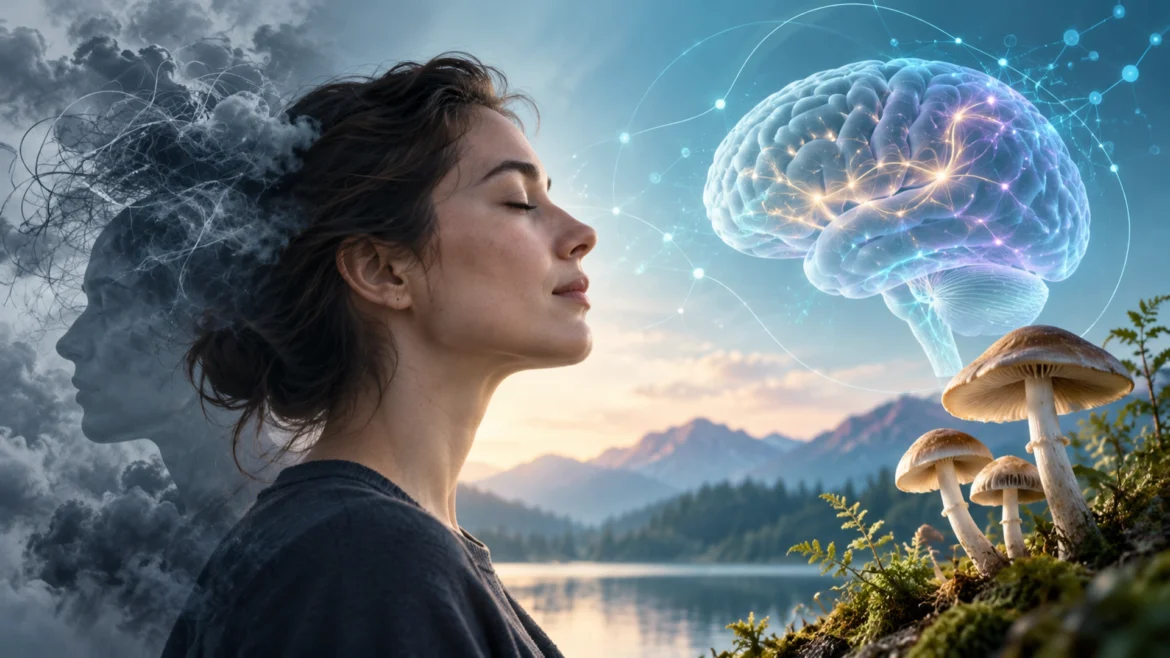
Psilocybin and anxiety have become an important area of psychedelic research as scientists investigate whether carefully supported psilocybin sessions can reduce certain forms of psychological distress. Some of the strongest findings so far come from studies involving people with cancer or other serious illnesses who were experiencing anxiety, depression, demoralization, or existential distress.
The results are promising, but they require careful interpretation. Psilocybin is not an established treatment for every anxiety disorder, and the strongest clinical studies do not resemble unsupervised use. Participants are typically screened, prepared in advance, monitored during the experience, and supported afterward. Psilocybin can also produce acute fear, anxiety, or panic during the experience itself.
Direct answer: Current research suggests that psilocybin-assisted therapy may reduce anxiety in some carefully selected patients, particularly those experiencing cancer-related or end-of-life psychological distress. However, evidence for primary anxiety disorders remains limited, and psilocybin can temporarily increase anxiety during the acute experience. More large, controlled studies are needed before broad treatment conclusions can be made.
Psilocybin and Anxiety: What Does the Research Actually Show?
Research on psilocybin and anxiety spans several overlapping areas: anxiety associated with cancer or serious illness, mixed anxiety and depression symptoms, existential distress, and broader psychiatric research. The strength of evidence is not the same across all of these categories.
A 2016 randomized, double-blind crossover trial involving 29 people with cancer-related anxiety and depression found substantial reductions in anxiety and depression after psilocybin administered with psychotherapy. At approximately six and a half months, many participants continued to show clinically significant improvements.
More recent reviews have continued to find encouraging signals, especially in palliative and cancer-related populations. A 2026 systematic review of pharmacological treatment for anxiety in end-of-life care reported that psilocybin studies showed rapid and sustained anxiety relief, while also emphasizing the small sample sizes and limited number of trials.
Why Cancer-Related Anxiety Has Been a Major Research Focus
People facing cancer or other life-threatening illnesses may experience anxiety that differs from everyday worry. Symptoms can include fear of death, uncertainty, loss of control, depression, demoralization, hopelessness, and existential distress.
These experiences can be difficult to treat because they are closely tied to real medical circumstances rather than irrational fear alone. This has made serious-illness populations an important setting for studying whether psilocybin-assisted therapy can change a person’s emotional relationship to illness, mortality, and meaning.
Several early modern clinical trials reported improvements not only in anxiety scores but also in quality of life, hopelessness, demoralization, and attitudes toward death. Those findings helped renew scientific interest in psychedelic-assisted approaches.
Does Psilocybin Help Generalized Anxiety Disorder?
At present, there is not enough evidence to say that psilocybin is an established treatment for generalized anxiety disorder, panic disorder, social anxiety disorder, or other primary anxiety disorders.
This distinction is important for SEO and AEO accuracy. Searchers often ask whether psilocybin “treats anxiety,” but the research base is more specific. Much of the strongest evidence comes from people experiencing anxiety and depression in the context of serious illness rather than from large trials focused exclusively on generalized anxiety disorder.
Future studies may clarify whether benefits extend to broader anxiety diagnoses, but current evidence does not justify assuming that all anxiety conditions respond in the same way.
How Might Psilocybin Affect Anxiety?
Scientists are investigating several overlapping mechanisms that may help explain the relationship between psilocybin and anxiety. No single explanation has been proven to account for the entire effect.
Serotonin 5-HT2A Receptor Signaling
Psilocybin is converted in the body into psilocin, which interacts with several serotonin receptors, especially the 5-HT2A receptor. This receptor plays an important role in the characteristic psychedelic effects and can influence perception, cognition, emotional processing, and cortical communication.
Our article on psilocybin vs. psilocin explains this conversion and receptor relationship in greater detail.
Changes in Brain Networks
Psilocybin can temporarily alter communication within and between large-scale brain networks. Research has reported reduced rigidity within established networks and increased communication between brain systems that are normally more segregated.
The Default Mode Network has received particular attention because of its role in self-referential thought, autobiographical memory, and internal narrative. Changes in rigid self-focused thinking are one possible mechanism being explored in anxiety and depression research.
Emotional Processing
Psilocybin can produce unusually intense emotional experiences. In supported settings, researchers are studying whether this temporary shift allows participants to engage with fear, grief, uncertainty, or difficult memories from a different perspective.
This should not be interpreted as proof that emotional intensity is automatically therapeutic. The same amplification of emotion can also produce significant distress.
Neuroplasticity
Psychedelic research also suggests that psilocybin may influence neuroplasticity, meaning the brain’s ability to modify neural connections and patterns of signaling. Scientists are investigating whether temporary increases in flexibility could support new learning or changes in entrenched thought patterns.
Our guide to psilocybin and neuroplasticity reviews that research in more depth.
Can Psilocybin Cause Anxiety During the Experience?
Yes. One of the most important facts about psilocybin and anxiety is that a substance being studied for possible long-term anxiety reduction can also produce substantial short-term anxiety.
Clinical and experimental studies have documented episodes of fear, panic, paranoia, confusion, and psychological distress during psilocybin sessions. In a controlled dose-response study, higher doses were associated with greater ratings of anxiety and fear, even though participants were carefully screened and supported.
This apparent contradiction is not unusual in psychedelic research. Acute emotional intensity and longer-term outcomes are different phenomena, and a difficult experience should never be assumed to be beneficial simply because some participants later report positive meaning.
What Is a Challenging Psilocybin Experience?
Researchers often use the term challenging experience to describe periods of fear, anxiety, panic, sadness, confusion, paranoia, or loss of control during a psychedelic state.
Some people later describe challenging experiences as personally meaningful, but others may experience lingering anxiety, derealization, sleep disturbance, or other psychological symptoms. Naturalistic and clinical reports show that adverse psychological effects can occur, even when the majority of participants do well.
For that reason, responsible research focuses not only on potential benefits but also on screening, supervision, adverse-event monitoring, and follow-up.
Why Set and Setting Matter in Psilocybin and Anxiety Research
The phrase set and setting refers broadly to a person’s mental state, expectations, emotional condition, and surrounding environment. These factors are especially relevant when studying psilocybin and anxiety because psychedelic experiences can amplify both positive and negative emotional material.
Clinical trials attempt to reduce avoidable distress by creating predictable environments, preparing participants beforehand, providing trained support during the session, and offering structured follow-up afterward.
This means the treatment being studied is not simply “take psilocybin.” The research intervention often includes preparation, controlled administration, professional monitoring, and psychological support.
How Psilocybin Clinical Trials Screen Participants
Clinical studies generally use extensive inclusion and exclusion criteria. Screening can include psychiatric history, medication use, cardiovascular health, substance-use history, current symptoms, and family history of certain psychiatric conditions.
Researchers may exclude people when they believe the risks of a psychedelic experience could outweigh potential benefits. This is one reason results from controlled trials should not automatically be generalized to the entire population.
Medication interactions are another important consideration. Anyone considering participation in legal clinical research should discuss medications and health conditions with qualified clinicians rather than stopping or changing prescribed medications independently.
Psilocybin and Anxiety Compared With Psilocybin and Depression
Anxiety and depression frequently overlap, and many psychedelic trials measure both at the same time. This makes it difficult to isolate one symptom domain completely.
For example, cancer-related trials often enrolled participants with both anxiety and depressive symptoms. Improvements could therefore reflect broader changes in psychological distress rather than a narrow anti-anxiety effect.
Mindwell’s article on psilocybin and depression looks more specifically at the depression literature.
What Do Systematic Reviews Say About Psilocybin and Anxiety?
Systematic reviews and meta-analyses generally describe psychedelic-assisted therapies as promising for anxiety and depression symptoms, but they also emphasize limitations in the evidence base.
Common limitations include:
- Small sample sizes
- Difficulty maintaining blinding because psychedelic effects are obvious
- Highly selected study participants
- Differences in dose, therapy model, and study design
- Overlap between anxiety, depression, and existential distress
- Limited long-term follow-up
- Potential expectancy effects
- A relatively small number of independent datasets
These limitations do not negate the positive findings, but they affect how confidently those findings can be generalized.
Is Psilocybin Approved for Anxiety?
No. Psilocybin is not currently an FDA-approved treatment for anxiety disorders.
Researchers are actively studying psychedelic-assisted approaches, and some jurisdictions have created limited legal frameworks for supervised psilocybin services. However, legal access, clinical approval, and scientific evidence are separate issues.
Promising research should therefore be described as experimental rather than as established medical treatment.
Who May Face Greater Risks?
Psychedelic research protocols are cautious because not everyone has the same risk profile. Certain psychiatric histories, medical conditions, medication combinations, or unstable circumstances may increase concern.
Potential risks can include acute panic, confusion, impaired judgment, increases in blood pressure or heart rate, nausea, headache, and—in a smaller number of cases—more persistent psychological symptoms.
Because individual risk cannot be determined from an online article, medical and psychiatric questions should be discussed with qualified healthcare professionals.
What Makes Clinical Psilocybin Research Different From Unsupervised Use?
This distinction is essential when interpreting psilocybin and anxiety research.
Clinical studies typically include:
- Medical and psychiatric screening
- Standardized or carefully measured psilocybin
- Preparation before the session
- A controlled physical environment
- Trained monitors or therapists
- Observation throughout the acute effects
- Follow-up and integration sessions
- Formal adverse-event reporting
Those safeguards are part of the research context. Clinical outcomes cannot be assumed to translate directly to uncontrolled settings.
How Long Can Anxiety Improvements Last?
Some studies have reported improvements that persisted for several months after a supported psilocybin session. In the well-known 2016 cancer trial, clinically significant reductions in anxiety and depression remained in many participants at approximately six and a half months.
However, duration varies between studies and individuals. Researchers are still studying what determines whether benefits persist, including psychological support, the quality of the experience, baseline characteristics, and changes in behavior or perspective after treatment.
Does a Mystical Experience Matter?
Several studies have reported correlations between the intensity of so-called mystical-type experiences and later improvements in anxiety or depression. These experiences may include feelings of unity, transcendence, profound meaning, or changes in the ordinary sense of self.
Correlation does not prove that a mystical experience is necessary for improvement. Researchers continue to debate how much therapeutic outcome depends on subjective experience versus receptor-level and neurobiological effects.
Our broader guide to what psilocybin does to the brain explores the relationship between receptor activity, brain networks, perception, emotion, and consciousness.
Common Misconceptions About Psilocybin and Anxiety
Myth: Psilocybin always reduces anxiety.
Reality: Psilocybin can acutely increase fear or anxiety, and not every participant benefits.
Myth: Research proves psilocybin treats every anxiety disorder.
Reality: The strongest evidence is currently concentrated in specific populations, especially people with serious-illness-related psychological distress.
Myth: A difficult experience is automatically therapeutic.
Reality: Challenging experiences can sometimes later be interpreted positively, but they can also be distressing or followed by adverse psychological symptoms.
Myth: Psilocybin works simply by increasing serotonin.
Reality: Psilocin acts at serotonin receptors, especially 5-HT2A, but downstream changes in brain networks, cognition, emotion, and neuroplasticity are also being studied.
Myth: Clinical trial results prove unsupervised use is equally effective.
Reality: Clinical research includes screening, controlled dosing, preparation, supervision, and follow-up that are absent in many uncontrolled settings.
Frequently Asked Questions
Research suggests that psilocybin-assisted therapy may reduce anxiety symptoms in some carefully screened patients, with some of the strongest evidence coming from studies involving people with cancer-related or end-of-life psychological distress. Evidence for primary anxiety disorders is less established.
Some controlled studies have reported anxiety reductions lasting for weeks or months after a supported psilocybin session. However, the durability of benefit varies, studies are still relatively small, and longer-term outcomes need more research.
Yes. Psilocybin can temporarily increase fear, anxiety, panic, confusion, or distress during the acute psychedelic experience, even in controlled studies. This is one reason clinical trials use screening, preparation, supervision, and follow-up.
Psilocybin is not an FDA-approved treatment for anxiety disorders. Research is ongoing, and promising study results should not be interpreted as proof that psilocybin is an established or appropriate treatment for every person with anxiety.
Researchers are studying several possible mechanisms, including serotonin 5-HT2A receptor signaling, changes in large-scale brain networks, reduced rigidity in self-referential thinking, emotional processing, and neuroplasticity. No single mechanism fully explains the observed effects.
Cancer-related anxiety can include fear, depression, demoralization, death anxiety, and existential distress associated with a serious diagnosis. Some of the best-known psilocybin studies have focused on this population under structured clinical conditions.
There is not yet enough high-quality evidence to say that psilocybin is an established treatment for generalized anxiety disorder. Much of the current anxiety evidence comes from mixed anxiety-depression samples or people experiencing distress related to serious illness.
No. Some participants later describe difficult experiences as meaningful, but acute fear or anxiety can still be intense and, in some cases, may be followed by ongoing psychological symptoms. Challenging experiences should not be assumed to be therapeutic.
Trials typically use medical and psychiatric screening, preparation sessions, trained monitors or therapists, controlled environments, careful observation during dosing, and structured follow-up. These safeguards are part of the intervention being studied.
Psilocybin is converted into psilocin, which interacts with several serotonin receptors, especially 5-HT2A receptors. This receptor activity can influence perception, emotion, cognition, and communication among brain networks involved in self-processing and emotional regulation.
What Current Research Tells Us About Psilocybin and Anxiety
Research into psilocybin and anxiety is one of the most promising—and frequently oversimplified—areas of psychedelic science. Controlled studies have reported meaningful reductions in anxiety and broader psychological distress, particularly among carefully screened people facing cancer or other serious illnesses.
At the same time, the evidence does not support treating psilocybin as a universal anxiety remedy. Psilocybin can temporarily increase fear and anxiety, the number of large controlled trials remains limited, and most positive studies include extensive preparation and psychological support.
The most accurate conclusion is therefore balanced: psilocybin-assisted therapy shows genuine promise for certain forms of anxiety and distress, but its effectiveness, safety, appropriate patient populations, and long-term role in mental healthcare are still being defined by ongoing research.
Research References
Pharmacological management of anxiety in end-of-life care: systematic review including psilocybin
Systematic review of randomized clinical trials examining psilocybin and psychiatric symptoms


