


Introduction
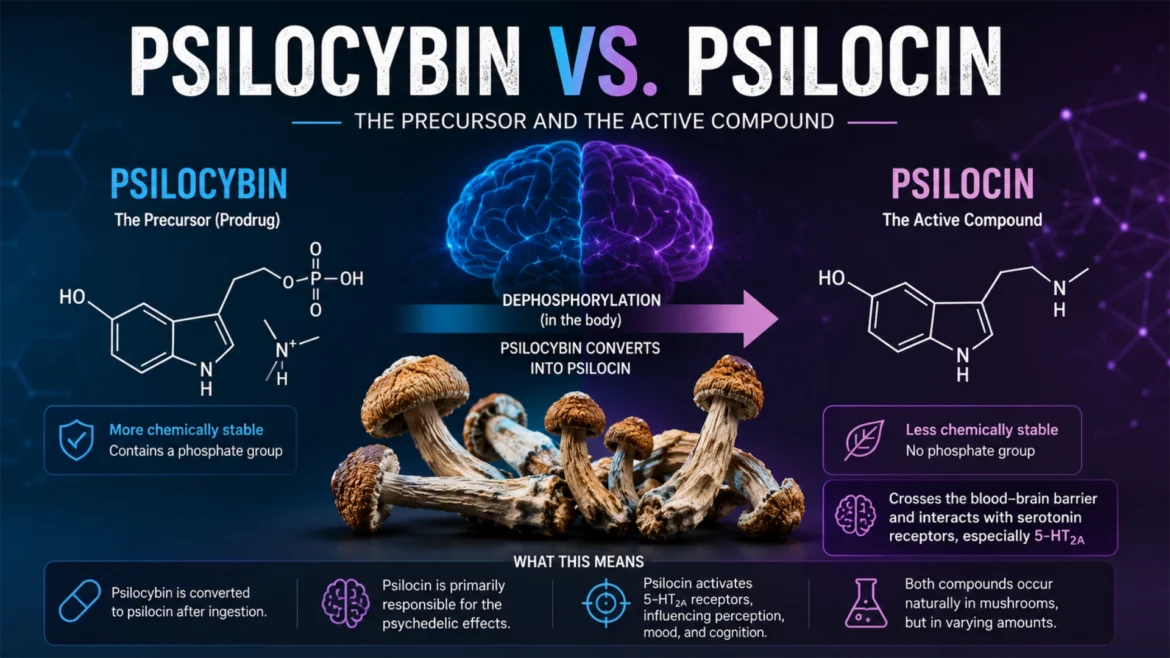
Psilocybin and psilocin are closely related naturally occurring compounds found in certain species of psychedelic mushrooms, but they do not play exactly the same role in the body. Although the terms are sometimes used interchangeably, understanding the difference between them is important for understanding how magic mushrooms produce their characteristic effects.
Psilocybin is generally considered a prodrug, meaning it is converted by the body into another active compound. After psilocybin is consumed, enzymes remove a phosphate group from the molecule through a process called dephosphorylation, producing psilocin.
Psilocin is the compound primarily responsible for the psychedelic effects associated with psilocybin mushrooms. Its molecular structure resembles the neurotransmitter serotonin, allowing it to interact with serotonin receptors throughout the brain—particularly the 5-HT2A receptor, which plays a central role in psychedelic effects involving perception, cognition, mood, and sensory processing.
This relationship can be summarized simply:
Psilocybin → conversion in the body → Psilocin → serotonin receptor activity → psychedelic effects
Understanding this conversion helps explain not only how psilocybin mushrooms work, but also why researchers distinguish between psilocybin and psilocin when studying mushroom potency, pharmacology, brain activity, and psychedelic-assisted therapy.
What’s the Difference Between Psilocybin and Psilocin?
Psilocybin is a naturally occurring psychedelic compound that acts primarily as a prodrug, while psilocin is its biologically active metabolite. After psilocybin enters the body, it is converted into psilocin, which crosses the blood-brain barrier and interacts primarily with serotonin 5-HT2A receptors to produce psychedelic effects.
Both compounds can occur naturally in psychedelic mushrooms, but psilocybin is generally more chemically stable than psilocin.
Psilocybin vs. Psilocin at a Glance
| Psilocybin | Psilocin | |
|---|---|---|
| What is it? | Naturally occurring psychedelic compound and prodrug | Active metabolite of psilocybin |
| Found in mushrooms? | Yes | Yes, in varying concentrations |
| Primary role | Precursor to psilocin | Produces most psychedelic effects |
| Conversion required? | Converted into psilocin | Already active |
| Primary brain target | Effects largely occur after conversion | Interacts strongly with 5-HT2A receptors |
| Relative stability | Generally more stable | More susceptible to oxidation and degradation |
The two compounds therefore should not be viewed as competing substances. They are parts of the same biological pathway.
Why the Difference Matters
Distinguishing psilocybin from psilocin helps clarify several concepts that are often oversimplified when discussing psychedelic mushrooms.
For example, when someone describes the “effects of psilocybin,” they are generally describing effects that occur largely after psilocybin has been converted into psilocin.
The distinction is also important when discussing:
- Mushroom potency
- Storage and degradation
- Psilocybin metabolism
- Serotonin receptor activity
- Psychedelic neuroscience
- Clinical psilocybin research
Researchers may administer carefully measured psilocybin in clinical studies, but understanding what happens afterward requires examining the pharmacology of psilocin.
Key Point to Understand
The simplest way to remember the difference is:
Psilocybin is primarily the precursor; psilocin is primarily the active compound.
After psilocybin is consumed, the body converts it into psilocin. Psilocin can then enter the brain and interact with serotonin receptors responsible for many of the characteristic psychological and perceptual effects associated with psychedelic mushrooms.
What Is Psilocybin?
Psilocybin is a naturally occurring psychedelic compound found in more than 200 species of fungi, including mushrooms belonging to genera such as Psilocybe, Panaeolus, and Gymnopilus. It belongs to a family of compounds known as tryptamines, which share structural similarities with serotonin and other naturally occurring molecules.
Although psilocybin is the compound most commonly associated with psychedelic mushrooms, its effects largely depend on what happens after it enters the body.
Psilocybin acts primarily as a prodrug. Rather than being responsible for most of the direct psychedelic activity in the brain, it is converted into the pharmacologically active compound psilocin.
Why Is Psilocybin Considered a Prodrug?
A prodrug is a substance that is converted within the body into a pharmacologically active compound.
In the case of psilocybin, enzymes remove a phosphate group from the molecule through dephosphorylation. This produces psilocin, which can more readily cross the blood-brain barrier and interact with serotonin receptors.
The basic pathway is:
Psilocybin → dephosphorylation → Psilocin → serotonin receptor activity
This conversion is fundamental to understanding the pharmacology of psilocybin mushrooms.
Where Is Psilocybin Found?
Psilocybin occurs naturally in numerous mushroom species distributed across different regions of the world.
However, the amount present is not consistent from one mushroom to another. Concentrations can vary according to factors including:
- Mushroom species
- Genetics
- Growing conditions
- Maturity at harvest
- Individual specimens
- Drying and processing
- Storage conditions
Because mushrooms are biological organisms rather than standardized pharmaceutical products, their chemical composition naturally varies.
This is one reason mushroom potency cannot be determined reliably from appearance alone.
Do All Psychedelic Mushrooms Contain the Same Amount of Psilocybin?
No. Psilocybin concentrations can differ substantially among species and individual mushroom samples.
Even mushrooms belonging to the same species or cultivated variety may contain different concentrations of active compounds. Environmental conditions, genetics, harvesting, drying, and storage can all contribute to this variability.
This natural variation is an important distinction between whole mushrooms and the precisely measured psilocybin used in controlled scientific research.
Why Is Psilocybin More Stable Than Psilocin?
One important chemical difference between psilocybin and psilocin is their relative stability.
Psilocybin contains a phosphate group that generally makes it more resistant to oxidation than psilocin. Psilocin contains a hydroxyl group that makes it more susceptible to chemical degradation when exposed to environmental conditions.
This difference helps explain why discussions about the long-term stability of psychedelic mushrooms often focus on how active compounds respond to:
- Oxygen
- Moisture
- Heat
- Light
- Storage duration
Over time, improper storage may contribute to degradation of active compounds and changes in potency.
Psilocybin in Scientific Research
Psilocybin has become an important compound in modern psychedelic research because researchers can administer precisely measured quantities under controlled conditions.
Clinical studies are investigating psilocybin in areas including:
- Depression
- Anxiety
- Substance use disorders
- Psychological distress associated with serious illness
- Brain connectivity
- Neuroplasticity
- Consciousness and perception
Using standardized psilocybin allows researchers to control dosage much more precisely than would be possible with naturally variable mushroom material.
Psilocybin Is Not the Same as the Mushroom
Another useful distinction is that psilocybin is a chemical compound, not a mushroom species or strain.
A psilocybin-containing mushroom is a biological organism containing numerous chemical compounds, potentially including psilocybin, psilocin, baeocystin, norbaeocystin, and many other naturally occurring substances.
Psilocybin is therefore one component of a considerably more complex biological material.
This distinction becomes particularly important when comparing clinical research involving purified psilocybin with claims about the effects of whole mushrooms.
Key Point to Understand
Psilocybin is a naturally occurring tryptamine compound found in numerous mushroom species and acts primarily as a precursor to psilocin. After consumption, the body removes its phosphate group, converting psilocybin into the active compound that interacts with serotonin receptors in the brain.
Its relative chemical stability and ability to be precisely measured have also made psilocybin the primary compound used in much of today’s clinical psychedelic research.
What Is Psilocin?
Psilocin is the primary psychoactive compound responsible for the characteristic psychedelic effects associated with psilocybin mushrooms. Although some mushrooms naturally contain psilocin, much of the psilocin responsible for their effects is produced after the body converts psilocybin into psilocin.
Psilocin belongs to the tryptamine family of compounds and has a molecular structure similar to serotonin, an important neurotransmitter involved in mood, perception, cognition, learning, and numerous other biological processes.
This structural similarity allows psilocin to interact with serotonin receptors throughout the brain.
Why Is Psilocin the Active Compound?
The chemical structure of psilocin allows it to cross the blood-brain barrier more readily than psilocybin.
Once it reaches the brain, psilocin interacts with several serotonin receptor subtypes. Of particular importance is the 5-HT2A receptor, which is widely considered one of the primary biological targets responsible for the characteristic psychedelic effects of psilocybin.
Activation of these receptors influences signaling across brain regions involved in:
- Perception
- Sensory processing
- Mood
- Cognition
- Emotional processing
- Self-awareness
- Attention
Researchers continue to investigate how these receptor interactions produce the complex psychological and neurological effects associated with psychedelics.
How Is Psilocin Related to Serotonin?
Psilocin and serotonin are different molecules, but their chemical structures share important similarities.
Serotonin—also known as 5-hydroxytryptamine or 5-HT—functions as a neurotransmitter throughout the brain and body. Because psilocin resembles serotonin structurally, it can bind to several of the same receptor families.
However, this does not mean psilocin simply behaves like additional serotonin.
Different molecules can interact with the same receptor in different ways, producing different patterns of cellular signaling. Researchers are actively studying these signaling differences to better understand psychedelic pharmacology.
The Role of the 5-HT2A Receptor
The 5-HT2A receptor is especially important because blocking this receptor can substantially reduce characteristic psychedelic effects in controlled research.
These receptors are highly expressed in areas of the cerebral cortex involved in complex cognitive and sensory processing.
When psilocin activates 5-HT2A receptors, researchers observe changes in patterns of neural activity and communication between brain networks.
These effects have become central to research investigating:
- Psychedelic perception
- Changes in consciousness
- Cognitive flexibility
- Brain connectivity
- Neuroplasticity
- Potential therapeutic mechanisms
The receptor does not explain every effect of psilocin, but it represents one of the most important pieces of the pharmacological puzzle.
Does Psilocin Occur Naturally in Magic Mushrooms?
Yes. Psilocin can occur naturally alongside psilocybin in psychedelic mushrooms.
However, the relative amounts of each compound can vary considerably between species and individual specimens.
Fresh mushrooms may contain measurable psilocin, while drying, handling, oxidation, and storage can influence its stability over time.
Because psilocin is less chemically stable than psilocybin, its concentration can be particularly sensitive to environmental conditions.
Why Is Psilocin Less Stable?
One of the defining chemical differences between psilocybin and psilocin involves the phosphate group present on the psilocybin molecule.
Psilocin lacks this phosphate group and contains a hydroxyl group that makes it more susceptible to oxidation.
Oxidation can contribute to chemical degradation, particularly when mushroom material is exposed to unfavorable environmental conditions.
This is one reason proper storage conditions matter when attempting to preserve mushroom potency over time.
Is Psilocin Responsible for Mushroom Bruising?
The blue coloration sometimes observed when psilocybin-containing mushrooms are bruised or damaged is associated with chemical reactions involving psilocin-related compounds.
Research suggests that damage to mushroom tissue can trigger enzymatic reactions involving psilocin, producing blue-colored compounds.
However, the intensity of blue bruising should not be treated as a reliable measurement of potency. A darker blue mushroom does not necessarily contain more psilocybin or produce stronger effects.
That’s an important distinction because “more blue means more potent” is frequently repeated online without adequate scientific support.
Psilocin in Psychedelic Research
Researchers study psilocin because understanding its activity helps explain what happens after psilocybin is administered.
Areas of research include:
- Serotonin receptor signaling
- Brain network connectivity
- Neuroplasticity
- Changes in perception
- Emotional processing
- Psychedelic-assisted therapy
- Pharmacokinetics
By studying both psilocybin and psilocin, scientists can better understand the complete pathway from administration to neurological effects.
Key Point to Understand
Psilocin is the primary pharmacologically active compound produced when the body converts psilocybin. Its structural similarity to serotonin allows it to interact with serotonin receptors—particularly the 5-HT2A receptor—producing changes in brain activity associated with psychedelic effects.
Psilocin also occurs naturally in some psychedelic mushrooms, but it is generally less chemically stable than psilocybin and more susceptible to oxidation and degradation.
Psilocybin vs. Psilocin — Key Differences
Psilocybin and psilocin are closely related chemically and biologically, but they are not interchangeable. The simplest distinction is that psilocybin primarily acts as a precursor, while psilocin is the compound primarily responsible for psychedelic activity in the brain.
Understanding their differences helps explain how psychedelic mushrooms produce effects, why active-compound concentrations can change during storage, and why scientific research often measures psilocybin and psilocin separately.
Psilocybin and Psilocin Compared
| Characteristic | Psilocybin | Psilocin |
|---|---|---|
| Compound type | Naturally occurring tryptamine | Naturally occurring tryptamine |
| Primary role | Prodrug / precursor | Pharmacologically active compound |
| Found naturally in mushrooms | Yes | Yes |
| Conversion required | Primarily converted into psilocin | Already active |
| Crosses blood-brain barrier | Less readily | More readily |
| Primary receptor activity | Effects largely follow conversion | Strong activity at serotonin receptors, especially 5-HT2A |
| Chemical stability | Generally more stable | More susceptible to oxidation |
| Role in psychedelic effects | Indirectly, primarily through conversion | Primarily responsible for psychedelic effects |
| Research importance | Commonly administered in clinical studies | Central to understanding pharmacological effects |
The relationship is therefore better understood as a biological sequence than as a competition between two separate psychedelic compounds.
Difference #1: Psilocybin Is Primarily a Precursor
Psilocybin contains a phosphate group that distinguishes its molecular structure from psilocin.
After consumption, this phosphate group is removed through dephosphorylation, converting psilocybin into psilocin.
This is why psilocybin is commonly described as a prodrug.
Difference #2: Psilocin Is Primarily Responsible for the Effects
Once formed, psilocin can cross the blood-brain barrier and interact with serotonin receptors.
Its activity at the 5-HT2A receptor is particularly important to the characteristic changes in perception, cognition, and consciousness associated with psychedelic effects.
Psilocin also interacts with other serotonin receptor subtypes, which researchers continue to investigate.
Difference #3: They Have Different Chemical Stability
Psilocybin is generally more stable than psilocin.
Psilocin is particularly susceptible to oxidation, which can contribute to degradation when mushroom material is exposed to environmental conditions such as oxygen, moisture, heat, and light.
This difference is relevant when researchers study mushroom potency and storage stability.
Difference #4: Both Can Exist in the Mushroom
It is sometimes assumed that mushrooms contain psilocybin while psilocin exists only after metabolism in the human body.
That isn’t quite correct.
Both psilocybin and psilocin can occur naturally in psychedelic mushrooms, although their concentrations vary considerably among species and individual specimens.
The body then converts additional psilocybin into psilocin following consumption.
Difference #5: Scientists Measure Them Separately
Laboratory analysis may measure psilocybin and psilocin individually because the concentration of each compound can provide useful information about mushroom chemistry.
This distinction becomes particularly important when comparing naturally variable mushroom material with purified psilocybin used in controlled clinical research.
A mushroom’s chemical composition cannot be determined accurately from its appearance, strain name, or bruising alone.
Are Psilocybin and Psilocin Equally Potent?
This question is somewhat misleading because the compounds perform different pharmacological roles.
Psilocin is the compound that directly interacts with brain receptors to produce most psychedelic effects, whereas psilocybin largely serves as the precursor from which psilocin is produced.
Researchers therefore often compare exposure using molecular measurements rather than treating equal physical quantities of psilocybin and psilocin as directly interchangeable.
Key Point to Understand
The most important differences between psilocybin and psilocin involve biological activity, metabolism, and chemical stability.
Psilocybin is the more stable precursor that the body converts into psilocin.
Psilocin is the less stable but pharmacologically active compound that crosses the blood-brain barrier and interacts with serotonin receptors, particularly 5-HT2A.
Both compounds may occur naturally within psychedelic mushrooms.
How Psilocybin Becomes Psilocin in the Body
The conversion of psilocybin into psilocin is one of the most important steps in understanding how psilocybin mushrooms affect the brain. After oral consumption, psilocybin is absorbed and rapidly dephosphorylated, meaning its phosphate group is removed to produce the pharmacologically active compound psilocin.
This process occurs as psilocybin passes through the digestive system and is metabolized, allowing psilocin to enter circulation and eventually reach the brain.
What Is Dephosphorylation?
Dephosphorylation is a chemical process in which a phosphate group is removed from a molecule.
Psilocybin is chemically known as 4-phosphoryloxy-N,N-dimethyltryptamine, while psilocin is 4-hydroxy-N,N-dimethyltryptamine.
Removing psilocybin’s phosphate group transforms the molecule into psilocin.
In simplified form:
Psilocybin → phosphate group removed → Psilocin
This seemingly small chemical change has an important biological consequence: psilocin is better able to cross the blood-brain barrier and interact with receptors in the central nervous system.
Where Does the Conversion Take Place?
Psilocybin-to-psilocin conversion is not confined to a single location.
Enzymatic dephosphorylation can occur in tissues involved in digestion and metabolism, including the intestinal tract and liver, with enzymes such as alkaline phosphatases contributing to the process.
By the time active compounds reach systemic circulation, psilocin becomes the primary molecule of interest when researchers examine psychedelic pharmacological effects.
Psilocin Enters the Bloodstream
Once formed, psilocin enters circulation and is distributed throughout the body.
Some of it reaches the brain, where it can cross the blood-brain barrier and interact with serotonin receptors. Other portions continue through metabolic pathways that prepare the compound for elimination.
The concentration of psilocin in the bloodstream changes over time as absorption, distribution, metabolism, and elimination occur simultaneously.
These processes form part of pharmacokinetics—the study of how a substance moves through the body.
Psilocin Crosses the Blood-Brain Barrier
The blood-brain barrier is a highly selective biological boundary that regulates which substances can move from circulating blood into brain tissue.
Psilocin’s chemical properties allow it to cross this barrier more readily than psilocybin.
Once inside the brain, psilocin can interact with several serotonin receptor subtypes, particularly 5-HT2A receptors.
These interactions contribute to changes in neural signaling and brain-network activity associated with psychedelic effects.
What Happens to Psilocin Afterward?
Psilocin does not remain active indefinitely.
The body continues metabolizing it through several pathways. One important process is glucuronidation, in which the body attaches glucuronic acid to psilocin, producing compounds that can be more readily eliminated.
Psilocin and its metabolites are then primarily cleared through the body’s normal elimination processes.
This gradual metabolism helps explain why psychedelic effects decrease over time rather than continuing indefinitely.
Conversion Does Not Happen According to an Exact Clock
Although the underlying biological pathway is consistent, the timing can differ among individuals.
Factors that may influence absorption and metabolism include:
- Digestive activity
- Recent food intake
- Individual physiology
- Liver metabolism
- Preparation method
- Other substances or medications
These differences contribute to variations in how quickly effects become noticeable and how long they persist.
This is one reason discussions of psilocybin onset time are generally presented as ranges rather than precise predictions.
Why This Process Matters in Clinical Research
Understanding the conversion of psilocybin into psilocin allows researchers to examine relationships between an administered amount of psilocybin, blood concentrations of psilocin, receptor activity, subjective effects, and the duration of those effects.
Researchers can use this information to study pharmacokinetics and pharmacodynamics:
Pharmacokinetics examines what the body does to a substance—absorption, distribution, metabolism, and elimination.
Pharmacodynamics examines what the substance does to the body, including interactions with receptors and resulting biological effects.
Both are important for understanding psilocybin scientifically.
Key Point to Understand
After psilocybin enters the body, enzymes remove its phosphate group through dephosphorylation, producing psilocin. Psilocin then enters circulation, crosses the blood-brain barrier, and interacts with serotonin receptors in the brain. The body subsequently metabolizes and eliminates psilocin, contributing to the gradual decline of its effects.
How Psilocin Interacts With Serotonin Receptors
Once psilocin reaches the brain, it interacts with several receptors belonging to the serotonin system. This interaction is central to understanding how a relatively small molecule can influence perception, cognition, mood, and communication between larger brain networks.
Psilocin does not simply “increase serotonin.” Instead, its molecular structure allows it to bind to and activate particular serotonin receptors, producing patterns of signaling that differ from serotonin’s normal activity.
Why Psilocin Resembles Serotonin
Serotonin, also called 5-hydroxytryptamine (5-HT), is a neurotransmitter involved in numerous functions throughout the brain and body.
These include:
- Mood regulation
- Learning and memory
- Sleep
- Sensory processing
- Appetite
- Cognition
- Emotional processing
Psilocin and serotonin share structural similarities because both belong to the broader tryptamine family.
That similarity allows psilocin to fit into several serotonin receptors and influence their activity.
What Is a Serotonin Receptor?
A receptor is a specialized protein that responds to particular chemical signals.
Serotonin does not have just one receptor. Scientists have identified multiple families and subtypes of serotonin receptors distributed throughout the brain and body.
Psilocin can interact with several of these receptors, including members of the 5-HT1 and 5-HT2 receptor families.
However, one receptor has received particularly significant attention in psychedelic research: 5-HT2A.
Why Is the 5-HT2A Receptor Important?
The 5-HT2A receptor is widely considered a primary molecular target responsible for the characteristic psychedelic effects of psilocin.
These receptors are especially prominent in areas of the cerebral cortex involved in higher-level processes such as:
- Perception
- Attention
- Cognition
- Self-awareness
- Sensory integration
- Emotional processing
When psilocin activates these receptors, it alters signaling within neurons and influences communication across larger neural networks.
Controlled studies using drugs that block 5-HT2A receptors have provided important evidence supporting the receptor’s central role in psychedelic effects.
Is Psilocin a 5-HT2A Agonist?
Psilocin is commonly described as a partial agonist at the 5-HT2A receptor.
An agonist is a substance that binds to a receptor and activates it. A partial agonist activates the receptor but does not necessarily produce the same maximum response as a full agonist under comparable conditions.
However, receptor pharmacology is more complicated than a simple on/off switch. Researchers continue to investigate how psilocin’s binding produces downstream signaling patterns and how those signals contribute to its broader neurological effects.
From One Receptor to Changes Across the Brain
One of the most interesting aspects of psychedelic neuroscience is that microscopic interactions at individual receptors can ultimately influence activity across entire brain networks.
Brain-imaging research involving psilocybin has identified temporary changes in:
- Functional connectivity
- Communication between brain regions
- Sensory processing
- Network organization
- Activity involving the Default Mode Network
- Patterns associated with cognitive flexibility
This helps explain why modern research looks beyond the question of which receptor psilocin binds to and examines how receptor activation affects the brain as an interconnected system.
Psilocin Does More Than Bind to 5-HT2A
Although 5-HT2A receives the greatest attention, psilocin is not exclusively active at this receptor.
It can interact with additional serotonin receptor subtypes, and researchers continue to investigate how these interactions may contribute to its overall pharmacological profile.
For this reason, saying that psilocin “works through the 5-HT2A receptor” is useful shorthand, but it should not be interpreted as meaning that 5-HT2A is the only receptor involved.
Serotonin and Psilocin Are Not Interchangeable
Because psilocin resembles serotonin and interacts with serotonin receptors, it can be tempting to describe psilocin as simply mimicking serotonin.
That’s an oversimplification.
The two molecules have different binding profiles and can produce different patterns of receptor signaling. Their effects also depend on receptor location, neural circuitry, concentration, and numerous biological variables.
The structural similarity helps explain why psilocin can interact with the serotonin system, but it does not make the compounds biologically identical.
Key Point to Understand
Psilocin interacts with several serotonin receptors, with the 5-HT2A receptor playing a particularly important role in its psychedelic effects. Psilocin acts as a partial agonist at 5-HT2A receptors, initiating cellular signaling that can ultimately influence communication across larger brain networks.
Its structural similarity to serotonin helps explain its ability to bind these receptors, but psilocin and serotonin are not the same compound and do not produce identical biological effects.
Do Magic Mushrooms Contain Both Psilocybin and Psilocin?
Yes. Psilocybin-containing mushrooms can naturally contain both psilocybin and psilocin, although the concentrations of these compounds vary considerably between species and individual specimens.
This is an important distinction because psilocin is not produced exclusively after psilocybin enters the human body. Some psilocin is already present within mushroom tissue, while additional psilocin is produced through metabolism after psilocybin is consumed.
The balance between these compounds is influenced by genetics, growing conditions, maturity, processing, drying, and storage.
Psilocybin and Psilocin Levels Vary Between Species
Different species of psychedelic mushrooms can have substantially different chemical profiles.
For example, mushrooms within the genus Psilocybe are commonly associated with psilocybin and psilocin, but concentrations are not uniform across every species.
Other psilocybin-containing genera may also exhibit different concentrations and ratios of active compounds.
This means that species identity can provide context about expected chemistry, but it cannot provide an exact measurement of potency.
Individual Mushrooms Can Also Vary
Variation isn’t limited to different species.
Individual mushrooms belonging to the same species—and even mushrooms originating from the same cultivation environment—can contain different concentrations of active compounds.
Factors that may contribute include:
- Genetics
- Growing conditions
- Developmental stage
- Environmental stress
- Harvest timing
- Individual biological variation
- Post-harvest handling
This natural variability is one reason precisely standardized clinical research generally relies on measured psilocybin rather than whole mushroom material.
Fresh vs. Dried Mushrooms
Drying changes mushrooms substantially by removing most of their water content.
The active compounds do not simply disappear when mushrooms are dried, but drying and subsequent storage conditions can influence their chemical stability.
Psilocin is particularly relevant because it is generally more susceptible to oxidation and degradation than psilocybin.
As a result, the relative concentrations found in fresh mushroom tissue may not remain identical after drying and extended storage.
Storage Can Affect Active Compounds
Once mushrooms have been harvested and dried, environmental conditions can influence how well their active compounds are preserved.
Factors associated with degradation include exposure to:
- Moisture
- Oxygen
- Heat
- Light
- Extended storage time
Because psilocin is comparatively unstable, poor storage conditions may particularly affect compounds susceptible to oxidation.
This is one reason discussions of shelf life, storage, and potency are closely related to the chemistry of psilocybin and psilocin.
Does Blue Bruising Reveal Psilocybin Content?
Not reliably.
Blue bruising is associated with chemical reactions involving psilocin-related compounds when mushroom tissue is damaged. However, the darkness or intensity of blue coloration does not provide a dependable measurement of how much psilocybin or psilocin a mushroom contains.
A mushroom that bruises heavily is therefore not automatically more potent than one displaying less visible bruising.
Accurate determination of active-compound concentration requires chemical analysis rather than visual inspection.
Can a Strain Name Tell You the Psilocybin Content?
A strain or cultivated-variety name may provide information about genetics or lineage, but it does not function like a standardized potency label.
Even mushrooms sold or cultivated under the same name can vary because active-compound production is affected by genetics, environmental conditions, harvesting, drying, and storage.
This is particularly important when comparing whole mushrooms with pharmaceutical or research-grade psilocybin, where the administered quantity can be measured precisely.
Why Chemical Analysis Matters
Researchers can use analytical techniques to measure individual compounds within mushroom samples.
Laboratory analysis allows scientists to distinguish between:
- Psilocybin
- Psilocin
- Related tryptamine compounds
- Other chemical constituents
This provides a much more reliable picture of mushroom chemistry than appearance, bruising, strain names, or subjective reports of potency.
Key Point to Understand
Magic mushrooms can naturally contain both psilocybin and psilocin. Their concentrations vary according to species, genetics, growing conditions, maturity, drying, handling, and storage.
Psilocin is generally less chemically stable than psilocybin, meaning its concentration may be particularly affected by oxidation and post-harvest conditions. Neither mushroom appearance, blue bruising, nor a strain name can reliably determine the concentration of these active compounds.
What Determines Psilocybin and Psilocin Levels in Mushrooms?
The amount of psilocybin and psilocin found in psychedelic mushrooms is not fixed. Even mushrooms that belong to the same species or cultivated variety can have different chemical profiles.
Researchers have identified several factors associated with variation in active-compound concentrations, including species, genetics, developmental stage, environmental conditions, post-harvest handling, drying, and storage.
This variability is one reason mushroom weight alone does not provide a precise measurement of psilocybin or psilocin content.
Mushroom Species
Species is one of the most important factors associated with differences in psilocybin and psilocin concentrations.
Different psilocybin-containing mushroom species can produce substantially different chemical profiles. Some species may contain higher concentrations of certain tryptamine compounds than others.
However, species identification still does not provide an exact measure of potency because considerable variation can occur within a single species.
Genetics
Genetic differences can influence the biological processes responsible for producing psilocybin, psilocin, and related compounds.
Even within the same species, different genetic lineages may express different chemical profiles. This helps explain why a species name—or a commercially used strain name—cannot guarantee a specific concentration of active compounds.
Mushroom Maturity
The chemical composition of a mushroom can change during development.
Researchers have investigated whether different developmental stages correspond with changes in concentrations of psilocybin, psilocin, and related compounds. Findings can vary depending on the species and conditions being studied.
For this reason, mushroom size or maturity alone should not be treated as a reliable indicator of potency.
Environmental Conditions
Environmental conditions can influence fungal growth and metabolism, potentially contributing to differences in chemical composition.
Factors associated with the growing environment may affect biological development, but their relationship with final alkaloid concentrations is complex. Genetics and natural specimen-to-specimen variation remain important.
This makes it difficult to predict chemical content based on a single environmental factor.
Drying and Post-Harvest Handling
Once mushrooms are harvested, their chemistry can continue to change.
Drying removes water and can help preserve mushroom material, but active compounds may still be affected by processing and environmental exposure.
Because psilocin is more susceptible to oxidation than psilocybin, post-harvest handling can influence the relative concentrations of the two compounds.
Storage Conditions
Long-term stability can also depend on how dried mushroom material is stored.
Exposure to heat, moisture, oxygen, and light may contribute to degradation of active compounds over time. Psilocin’s lower chemical stability makes oxidation particularly relevant.
This helps explain why mushroom age alone cannot tell you how much potency has been retained. The conditions experienced during storage also matter.
Why Weight Doesn’t Equal Active-Compound Content
Two mushroom samples of identical weight do not necessarily contain identical amounts of psilocybin or psilocin.
This is an important distinction when interpreting discussions about magic mushroom dosage. Weight measures the amount of mushroom material; it does not directly measure the quantity of active compounds within that material.
Laboratory research using standardized psilocybin avoids much of this uncertainty because researchers can administer a known quantity of the isolated compound.
Can Appearance Predict Potency?
No reliable visual characteristic can precisely determine psilocybin or psilocin concentration.
Features such as:
- Mushroom size
- Cap shape
- Color
- Blue bruising
- Stem thickness
should not be treated as chemical measurements.
Laboratory analysis is required to accurately quantify active-compound concentrations.
Key Point to Understand
Psilocybin and psilocin concentrations vary naturally among psychedelic mushrooms. Species and genetics contribute to these differences, while maturity, environmental conditions, drying, handling, and storage may further influence the final chemical profile.
This natural variability means mushroom weight, appearance, bruising, or strain names cannot reliably reveal the precise amount of psilocybin or psilocin present.
What Current Research Is Studying
Scientific interest in psilocybin and psilocin has expanded considerably in recent years. Researchers are studying not only their psychedelic effects, but also their pharmacology, effects on brain connectivity, relationship to neuroplasticity, and possible roles in carefully controlled therapeutic settings.
Much of this research uses precisely measured psilocybin rather than whole mushrooms. This allows scientists to control the administered amount and examine how psilocybin is converted into psilocin and how resulting concentrations relate to neurological and psychological effects.
Psilocybin-Assisted Therapy
One major area of research involves psilocybin-assisted therapy, in which measured psilocybin is administered within a structured clinical environment that may include screening, preparation, professional supervision, and psychological support.
Researchers have investigated this approach in connection with conditions including:
- Major depressive disorder
- Treatment-resistant depression
- Anxiety and distress associated with serious illness
- Alcohol use disorder
- Tobacco dependence
Some clinical trials have reported promising outcomes, but research remains ongoing. Psilocybin-assisted therapy should therefore not be interpreted as equivalent to unsupervised psychedelic use or as an established treatment for every condition being investigated.
Psilocin and Brain Connectivity
Modern neuroimaging allows researchers to investigate how psilocin-related receptor activity corresponds with changes across larger brain networks.
Studies have reported temporary alterations in functional connectivity, including changes in communication between brain regions that ordinarily operate within more established network patterns.
One frequently studied system is the Default Mode Network (DMN), a collection of interconnected brain regions associated with self-referential thinking and internally focused mental activity.
Scientists continue to investigate how these temporary network changes relate to subjective psychedelic experiences and whether they contribute to longer-lasting psychological outcomes.
Neuroplasticity
Another important research area is neuroplasticity, the brain’s ability to change and reorganize neural connections.
Laboratory and animal studies involving psychedelic compounds have identified changes associated with:
- Dendritic growth
- Synaptic connectivity
- Neural signaling
- Structural plasticity
Human research is considerably more complex, and scientists are still working to determine how these biological observations translate into lasting changes in people.
Researchers are particularly interested in whether temporary periods of altered neural flexibility could help explain some outcomes observed in clinical studies.
The 5-HT2A Receptor and Therapeutic Effects
Because psilocin’s activity at 5-HT2A receptors is strongly associated with psychedelic effects, researchers are studying whether activation of this receptor also contributes to potential therapeutic outcomes.
One major question is whether the subjective psychedelic experience itself is necessary for therapeutic effects or whether certain biological mechanisms might eventually be separated from those experiences.
This remains an active and unresolved area of research.
Pharmacokinetics and Individual Differences
Scientists are also studying why individuals can respond differently to the same measured amount of psilocybin.
Research into pharmacokinetics examines factors such as:
- Absorption
- Conversion of psilocybin into psilocin
- Blood concentrations of psilocin
- Distribution through the body
- Metabolism
- Elimination
Understanding these differences may eventually help researchers better predict the timing and intensity of responses within controlled clinical settings.
Psilocybin, Psilocin, and Mental Health Research
Research involving psilocybin is particularly notable because psychological effects may sometimes persist beyond the period during which psilocin produces acute psychedelic effects.
Scientists are investigating whether these longer-term outcomes involve some combination of:
- Neuroplasticity
- Changes in brain-network activity
- Emotional processing
- Psychological insight
- Therapeutic support
- Environmental context
- Individual differences
Current evidence does not support reducing these outcomes to a single mechanism.
Why Controlled Research Matters
Clinical psychedelic research differs substantially from observations involving recreational or unsupervised use.
Research protocols may include:
- Carefully measured compounds
- Participant screening
- Controlled environments
- Professional supervision
- Psychological preparation
- Follow-up assessment
These controls help scientists distinguish pharmacological effects from other variables and evaluate potential benefits and risks more systematically.
Key Point to Understand
Current research is examining psilocybin and psilocin at multiple levels—from individual serotonin receptors to entire brain networks and clinical outcomes.
Scientists are investigating how psilocybin is metabolized into psilocin, how psilocin affects 5-HT2A receptor signaling, whether these effects influence neuroplasticity and brain connectivity, and how these mechanisms may relate to outcomes observed in carefully controlled clinical research.
Although findings in several areas are promising, many questions remain unresolved, and continued research is necessary before broader conclusions can be drawn.
Common Misconceptions About Psilocybin and Psilocin
Because psilocybin and psilocin are closely related, the two terms are frequently used interchangeably in articles, social media discussions, and everyday conversation. While this shorthand is understandable, it can create confusion about how these compounds actually function.
Separating a few common misconceptions from the current scientific understanding provides a clearer picture of their relationship.
Misconception: Psilocybin and Psilocin Are the Same Compound
Psilocybin and psilocin are different but closely related molecules.
Psilocybin contains a phosphate group that psilocin does not. After psilocybin enters the body, this phosphate group is removed through dephosphorylation, producing psilocin.
Their relationship can be summarized as:
Psilocybin → dephosphorylation → Psilocin
That chemical difference is small enough for the compounds to be closely related but significant enough to affect their biological activity and chemical stability.
Misconception: Psilocybin Directly Produces All Psychedelic Effects
Psilocybin is generally considered a prodrug, meaning much of its pharmacological activity occurs after it has been converted into psilocin.
Psilocin crosses the blood-brain barrier and interacts with serotonin receptors, particularly 5-HT2A receptors, producing many of the neurological effects associated with psilocybin mushrooms.
For this reason, discussions of the “effects of psilocybin” frequently describe effects mediated largely by psilocin.
Misconception: Magic Mushrooms Contain Psilocybin but Not Psilocin
Both compounds can occur naturally in psychedelic mushrooms.
The relative concentrations vary among species, individual mushrooms, and samples. Additional psilocin is then produced when the body metabolizes psilocybin after consumption.
Psilocin is therefore both a naturally occurring mushroom compound and a metabolite of psilocybin.
Misconception: Psilocin Is Just Serotonin
Psilocin and serotonin share structural similarities, but they are not the same molecule.
Their similarity allows psilocin to interact with several serotonin receptors. However, psilocin and serotonin have different receptor-binding profiles and can produce different patterns of cellular signaling.
Saying that psilocin simply “becomes serotonin” or functions exactly like serotonin is therefore inaccurate.
Misconception: Psilocybin Increases Serotonin Levels
Psilocybin’s psychedelic effects are not adequately explained by saying it simply increases the amount of serotonin in the brain.
After conversion into psilocin, the active compound interacts directly with several serotonin receptor subtypes, particularly 5-HT2A receptors.
Receptor activation and serotonin concentration are different biological concepts.
Misconception: Blue Bruising Shows How Much Psilocybin Is Present
Blue bruising is associated with chemical reactions involving psilocin-related compounds following damage to mushroom tissue.
However, the amount or darkness of blue coloration is not a reliable measurement of psilocybin concentration or overall potency.
Accurately determining active-compound concentrations requires laboratory chemical analysis.
Misconception: Strain Names Tell You Exactly How Potent a Mushroom Is
A strain or cultivated-variety name does not function as a standardized chemical label.
Active-compound concentrations can vary due to genetics, growing conditions, maturity, drying, storage, and individual biological variation.
Two mushroom samples carrying the same name can therefore have different concentrations of psilocybin and psilocin.
Misconception: Psilocin Disappears Immediately When the Effects End
The subjective psychedelic experience and the body’s metabolism of psilocin do not end at precisely the same moment.
The body continues metabolizing and eliminating compounds as their concentrations decrease. This means duration of noticeable effects and complete metabolic elimination are different timelines.
Misconception: Scientists Already Understand Exactly How Psilocybin Works
Researchers understand important parts of psilocybin pharmacology, including its conversion into psilocin and the importance of 5-HT2A receptor activity.
However, major questions remain about how receptor-level activity produces complex changes across brain networks and how these effects relate to neuroplasticity and longer-term psychological outcomes.
The science continues to evolve.
Key Point to Understand
The most important distinction is straightforward: psilocybin and psilocin are closely related but different compounds. Psilocybin acts primarily as a precursor, while psilocin is the active compound that interacts with serotonin receptors in the brain.
Neither blue bruising, strain names, nor mushroom appearance provides a reliable measurement of their concentrations, and the relationship between these compounds and the brain is considerably more complex than simply “increasing serotonin.”
Frequently Asked Questions About Psilocybin and Psilocin
Psilocybin primarily acts as a prodrug or precursor, while psilocin is the pharmacologically active compound responsible for most psychedelic effects. After psilocybin is consumed, the body removes its phosphate group and converts it into psilocin, which can cross the blood-brain barrier and interact with serotonin receptors.
Yes. After consumption, psilocybin undergoes dephosphorylation, a process that removes its phosphate group and produces psilocin. This conversion occurs as psilocybin is absorbed and metabolized by the body.
Psilocin is primarily responsible for the direct psychoactive effects. Psilocybin is generally considered a prodrug because much of its activity depends on conversion into psilocin.
Yes. Psychedelic mushrooms can naturally contain both psilocybin and psilocin. Their concentrations can vary according to species, genetics, growing conditions, maturity, drying, handling, and storage.
No. Psilocin and serotonin are different molecules, although they share structural similarities. This similarity allows psilocin to interact with several serotonin receptors, particularly the 5-HT2A receptor, but the two compounds do not produce identical biological effects.
It is more accurate to say that psilocybin is converted into psilocin, which then interacts with serotonin receptors. The psychedelic effects of psilocybin are not adequately explained as simply increasing the amount of serotonin in the brain.
Psilocin interacts with several serotonin receptor subtypes, but the 5-HT2A receptor is considered particularly important to its characteristic psychedelic effects. Psilocin is commonly described as a partial agonist at this receptor.
Psilocybin contains a phosphate group that contributes to greater chemical stability. Psilocin lacks this phosphate group and is more susceptible to oxidation and degradation, making environmental conditions such as oxygen, moisture, heat, and storage particularly relevant.
No. Blue bruising is associated with chemical reactions involving psilocin-related compounds after mushroom tissue is damaged, but the intensity of bruising does not reliably measure psilocybin concentration or mushroom potency.
No. Appearance, size, cap shape, stem thickness, bruising, and strain names cannot accurately determine psilocybin or psilocin concentrations. Reliable measurement requires laboratory chemical analysis.
Psilocybin’s greater chemical stability and ability to be precisely measured make it well suited to controlled research. After administration, researchers can study its conversion into psilocin and examine relationships between psilocin concentrations, receptor activity, subjective effects, and clinical outcomes.
Yes. Researchers continue to investigate psilocybin and psilocin in areas including serotonin receptor signaling, brain connectivity, neuroplasticity, pharmacokinetics, depression, anxiety, substance use disorders, and psychedelic-assisted therapy. Although scientists understand important aspects of their pharmacology, many questions about longer-term neurological and therapeutic effects remain under investigation.
In Conclusion
Understanding the Relationship Between Psilocybin and Psilocin
Psilocybin and psilocin are closely related compounds, but understanding the difference between them provides a much clearer picture of how psychedelic mushrooms affect the brain and body.
Psilocybin primarily acts as a precursor or prodrug. After consumption, the body removes its phosphate group through dephosphorylation, converting it into psilocin, the compound primarily responsible for psychedelic effects.
Once formed, psilocin can cross the blood-brain barrier and interact with several serotonin receptors, particularly the 5-HT2A receptor. These interactions influence neural signaling and communication across brain networks involved in perception, cognition, sensory processing, emotional experience, and other aspects of consciousness.
The distinction also matters when examining mushrooms themselves. Both psilocybin and psilocin can occur naturally in psychedelic mushrooms, but their concentrations vary among species and individual specimens. Genetics, maturity, environmental conditions, drying, handling, and storage conditions can all influence their chemical profiles. Psilocin is also generally more susceptible to oxidation and degradation than psilocybin.
This natural variability helps explain why mushroom potency cannot be determined accurately from weight, appearance, strain name, or blue bruising alone. It also highlights an important difference between whole mushrooms and controlled clinical research using precisely measured psilocybin.
Scientific research continues to explore this relationship at multiple levels—from the conversion of psilocybin into psilocin and activation of serotonin receptors to larger questions involving brain connectivity, neuroplasticity, and psychedelic-assisted therapy. Although researchers understand many important aspects of this pathway, the mechanisms connecting receptor activity with complex psychological and longer-term effects remain an active area of investigation.
Ultimately, the difference between these compounds can be summarized simply:
Psilocybin is primarily the precursor. Psilocin is primarily the active compound.
Understanding that relationship provides a foundation for exploring the broader science of psilocybin mushrooms, including magic mushroom dosage, psilocybin onset time, mushroom potency, storage and degradation, and the continuing research into how psychedelics interact with the human brain.


