


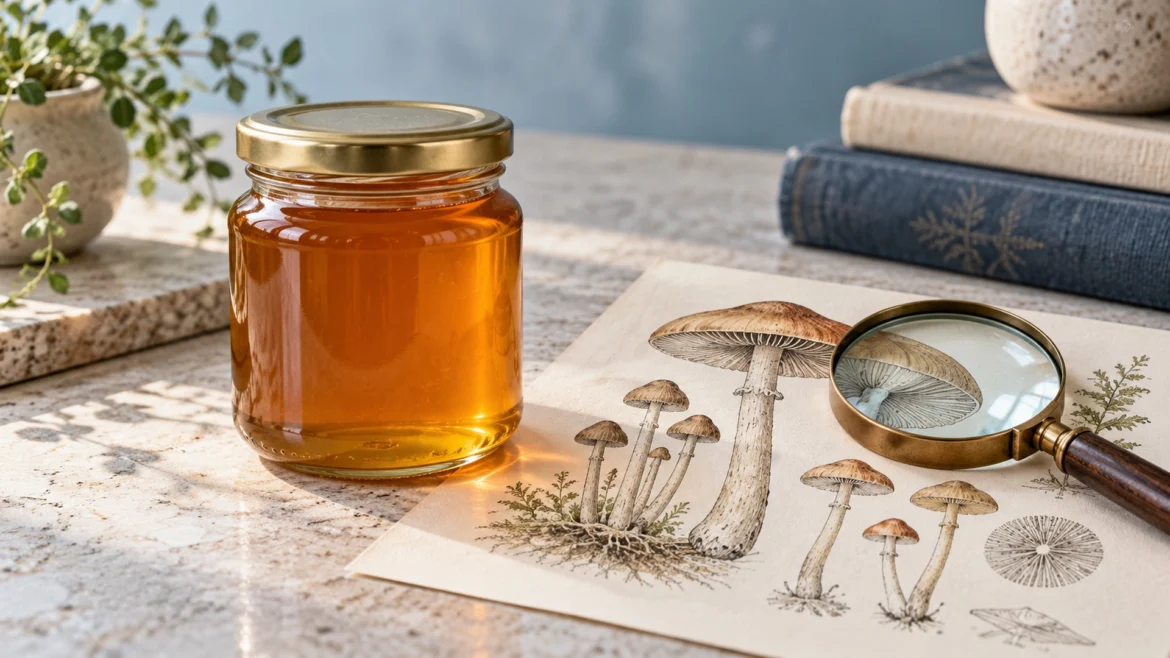
Magic mushroom honey, often called blue honey, is honey containing psilocybin-producing mushroom material. It is a topic of interest because of claims about preservation, potency, and health benefits. However, a familiar food ingredient does not make a psychoactive mixture predictable, medically validated, or safe.
This educational guide separates established research from assumptions. It explains the terminology, the chemistry behind blue coloration, the limits of shelf-life claims, and the difference between food safety and chemical stability. It also provides questions readers can use to evaluate online claims.
Quick answer: The scientific sources reviewed here do not establish a validated shelf life, predictable potency, or proven therapeutic benefit for magic mushroom honey. Research on ordinary honey or supervised psilocybin therapy should not be treated as evidence about this mixture.
Article reviewed: October 12, 2026. This article provides general education, not preparation instructions, dosing advice, or medical treatment recommendations.
Explore this guide: Definition · Blue coloration · Shelf-life evidence · Risks · FAQs.
What Is Magic Mushroom Honey?
Magic mushroom honey is an informal description of a mixture, rather than a standardized scientific formulation. Two jars with the same name may differ in their ingredients and chemical composition. A name, photograph, or description is not enough to establish what a jar contains.
The word “mushroom” also needs context. Ordinary culinary mushrooms, nonpsychoactive mushroom extracts, and psilocybin-producing mushrooms are different categories. A claim about one category cannot automatically be transferred to another. Similarly, evidence about plain honey does not establish the properties of honey containing additional material.
When evaluating an article or label, start with the specific claim. Is the writer describing an ingredient, reporting a measured chemical concentration, or asserting a health benefit? Those are separate statements and require different evidence.
Why Is It Called Blue Honey?
The nickname refers to the blue coloration associated with certain psilocybin-producing mushrooms. A primary study by Lenz and colleagues investigated enzyme-driven reactions that produce blue compounds following injury to mushroom tissue. The work linked the coloration to oxidation and the formation of larger molecular products from psilocin.
That chemistry helps explain the nickname, but it does not turn color into a laboratory test. A blue appearance cannot establish a mixture’s identity, concentration, or safety. The study examined mushroom chemistry; it did not validate a color chart for assessing honey preparations.
A useful distinction is between an observation and a measurement. “This sample appears blue” is an observation. “This sample contains a specified concentration of psilocybin” requires an appropriate analytical method. Treating the first statement as proof of the second skips an essential step.
Does Honey Reliably Preserve Psilocybin?
Honey’s properties have prompted preservation claims, but the reasoning often goes too far. Research on water activity in honey and model honey solutions concerns the relationship between water availability and composition. It does not establish a shelf life for mushroom-containing honey.
Water activity describes how available water is within a material. It is not simply a visual assessment of whether something looks wet or dry. Once a food contains additional ingredients, claims about the original ingredient need to be reconsidered for the finished mixture.
There are also two distinct questions: whether microorganisms can grow and whether particular chemical compounds remain stable. A product could meet one criterion and fail another. Honey’s reputation as a long-lasting food is therefore not evidence that psilocybin concentration remains unchanged.
For a preservation claim to be convincing, researchers would need to define the formulation, test representative samples, and measure relevant outcomes over time. An anecdote about an old jar cannot substitute for those data.
Magic Mushroom Honey Shelf Life: What Is Known?
The sources reviewed for this article do not establish a validated expiration period for magic mushroom honey. A study by Gotvaldová and colleagues examined psilocybin and related compounds in Psilocybe cubensis biomass under processing and storage conditions. It found changes in measured compounds over time, but did not test a mushroom-honey formulation.
Its results should not be converted into a claim that blue honey lasts a particular number of months or years. Different materials require their own evidence. Chemical stability findings from mushroom biomass are not a finished-food safety assessment.
Three terms are often confused:
- Quality: appearance, texture, flavor, or other sensory properties.
- Food safety: whether contamination or other hazards make a material unsafe.
- Chemical stability: whether a measured compound changes over time.
A single phrase such as “still good” does not tell readers which of these outcomes was assessed. Whenever a shelf-life claim appears online, ask what was tested, how it was tested, and whether the evidence actually concerns the same mixture.
Potency and Consistency Are Separate From Appearance
A spoon measures volume; it does not measure psilocybin concentration. Likewise, the weight of a honey mixture does not reveal the amount of a specific compound within it. Those distinctions matter when a writer implies that a familiar household measure guarantees predictability.
Unevenly distributed material creates another uncertainty. Even a concentration measurement from one sample would need appropriate sampling to support claims about an entire jar. A precise-looking number is not automatically reliable if the sampling method is unclear.
Claims that blue honey becomes stronger with age also need direct evidence. Darkening, blue coloration, settling, or a change in texture does not demonstrate increasing psychoactive concentration. Appearance alone cannot resolve these questions.
Magic Mushroom Honey Benefits: Claims Versus Evidence
Discussions of magic mushroom honey often combine three different ideas: honey’s familiar taste, the effects of psilocybin, and the outcomes of clinical research. Combining those ideas does not establish a health benefit for the mixture.
The National Center for Complementary and Integrative Health describes research into psilocybin for mental health conditions alongside significant uncertainties and risks. Clinical research involves defined study materials, screening, and support. It does not establish that a homemade honey preparation provides the same results.
A testimonial may describe someone’s experience, but it cannot establish why that experience occurred. Expectations, other treatments, and unrelated changes can influence how someone feels. A treatment claim requires research designed to address such competing explanations.
The right question is therefore specific: has this preparation been studied for this outcome in this population? Evidence about another substance, another preparation, or another clinical setting does not answer that question.
Magic Mushroom Honey Risks and Food Safety
Consider both the psychoactive ingredient and the food mixture. Uncertain chemical composition is one concern; possible food contamination is another. Neither concern disappears because honey is familiar or because the mixture looks normal.
NCCIH reports that psilocybin can cause unpredictable experiences, fear, confusion, nausea, and increases in heart rate or blood pressure. It also notes important mental health risks and uncertainty about microdosing. Honey does not remove those risks. People with health concerns or taking medicines should discuss them with a qualified clinician rather than changing treatment based on online claims.
The FDA’s food-storage guidance emphasizes that food can cause illness without looking, smelling, or tasting spoiled. Visible mold or a suspicious smell is a reason to discard a questionable mixture, but the absence of those signs is not proof of safety. Do not taste an unidentified or suspicious preparation to test it.
Keep psychoactive mixtures clearly identified and inaccessible to children and pets. Do not serve them as ordinary honey. Separately, the CDC advises against giving any honey to infants younger than 12 months because of infant botulism risk.
Does Crystallization Mean Blue Honey Has Gone Bad?
Crystallization and contamination are different concepts. Honey can develop crystals, but texture alone cannot answer whether a mixture containing other ingredients is safe. The same caution applies to settling or differences in color.
An online photograph cannot replace a safety assessment. Readers should be skeptical of claims that every unusual appearance is harmless or, conversely, that one visual feature proves a particular hazard. If the identity or condition of a mixture is uncertain, do not consume it.
How to Evaluate Online Blue Honey Claims
A strong educational explanation should show where its evidence comes from and state its limits. These questions help distinguish supported information from confident speculation:
- What exactly was studied? Plain honey, mushroom biomass, purified psilocybin, or the finished mixture?
- What outcome was measured? Microbial growth, chemical concentration, sensory quality, or a clinical effect?
- Were measurements repeated? A single observation does not establish stability over time.
- Was sampling explained? Evidence from one sample may not describe an entire mixture.
- Are the conclusions proportionate? Words such as “guaranteed,” “permanent,” and “proven” require strong evidence.
- Are uncertainties acknowledged? A useful source should distinguish what is known from what remains untested.
For example, a statement that honey is a shelf-stable food does not prove a mushroom mixture is shelf-stable. A clinical trial involving psilocybin does not prove a honey preparation treats depression. These are errors of inference, even when the underlying research is real.
Frequently Asked Questions About Magic Mushroom Honey
Magic mushroom honey is honey containing psilocybin-producing mushroom material. Blue honey is a common informal name. The name does not establish its composition, potency, safety, or medical benefits.
No. Blue honey is an informal name, not a required color specification. Blue coloration can be associated with oxidation reactions in mushroom compounds, but color cannot establish identity, concentration, or safety.
The sources reviewed for this article do not establish a validated shelf life for magic mushroom honey. Ordinary honey’s shelf stability cannot be used to assign an expiration date to a mixture containing other ingredients.
Honey research and mushroom stability research do not establish that honey reliably preserves psilocybin in a finished mixture. A preservation claim requires testing of the actual formulation over time.
There is no reliable basis in the research reviewed here for claiming that blue honey becomes stronger with age. Color changes, texture, and time in a jar are not potency measurements.
No. Research on supervised psilocybin therapy does not establish that magic mushroom honey treats a mental health condition. Homemade mixtures differ from the materials and clinical conditions used in studies.
Spoon size and the weight of honey do not reveal its psilocybin concentration. Unknown composition and uneven distribution make appearance-based estimates unreliable.
Crystallization alone is not proof of spoilage, but it also cannot establish the safety of a mushroom-containing mixture. Do not consume a suspicious or unidentified mixture, and do not taste it to test safety.
Conclusion: Read the Evidence Behind the Name
Magic mushroom honey is best understood as an informal mixture with unanswered questions about composition, stability, and safety. The name “blue honey” does not supply the missing evidence. Neither does honey’s long history as a food.
The most useful approach is to separate a product description from a scientific finding. Look for studies of the actual material and the actual outcome being claimed. Where those studies are absent, uncertainty should remain explicit. Educational content should help readers recognize those limits.
This guide is part of Mindwell’s Classhroom educational collection. For health-related decisions, prioritize qualified clinical advice and research that directly addresses the question at hand.
Scientific References and Further Reading
- Lenz et al. — Injury-Triggered Blueing Reactions of Psilocybe “Magic” Mushrooms (2020). Primary chemistry research.
- Gotvaldová et al. — Stability of psilocybin and its four analogs in mushroom biomass (2021). Primary stability research; not a honey study.
- A review, analysis and extension of water activity data of sugars and model honey solutions (2020). Honey composition research.
- NCCIH — Psilocybin for Mental Health and Addiction: What You Need To Know.
- FDA — Are You Storing Food Safely?
- CDC — Foods and Drinks to Avoid or Limit: Honey Before 12 Months.


