


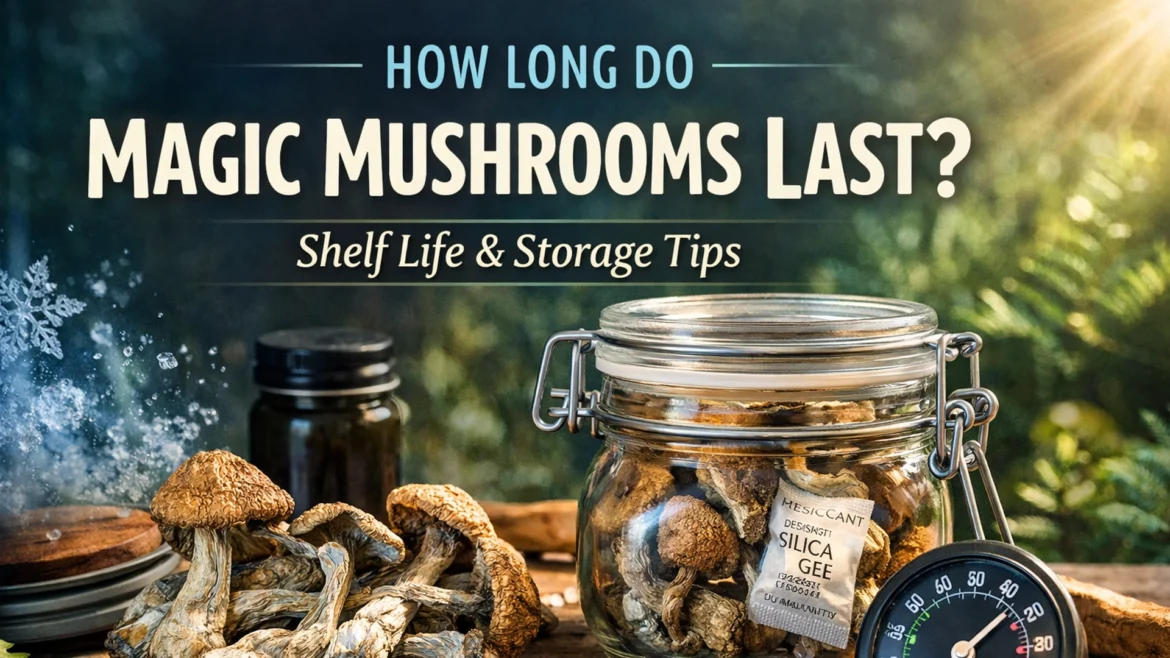
How long do magic mushrooms last? There is no single validated shelf-life period that applies to every psilocybin-containing mushroom or preparation. Age, appearance, and packaging alone cannot establish whether a sample is safe or how much of a particular compound remains.
This educational guide focuses on shelf life before use, rather than the duration of psychedelic effects. It explains what laboratory research can tell us, why fixed expiration ranges need caution, and how food safety differs from sensory quality and chemical potency.
Quick answer: The sources reviewed do not support a universal promise that fresh mushrooms are safe for a fixed number of days or that dried mushrooms retain most of their potency for a year or longer. A claim about a specific sample requires evidence relevant to that sample and the outcome being assessed.
Reviewed: October 12, 2026. This guide provides general education and safety information, not preparation, preservation, dosing, or medical instructions.
Jump to: Shelf-life answer · Safety versus potency · Research · Warning signs · FAQs.
How Long Do Magic Mushrooms Last? Understanding the Question
The phrase can refer to two very different questions: how long material remains suitable before use, or how long psychoactive effects continue after exposure. This article addresses the first question. Mixing the two creates confusing answers and misleading comparisons.
Even within shelf-life discussions, the word “last” is ambiguous. It may refer to recognizable appearance, absence of spoilage, or the concentration of a chemical compound. Those outcomes do not have the same meaning.
For example, a sample could look unchanged while its chemical composition differs from an earlier measurement. Conversely, detecting a psychoactive compound does not establish that a sample is free from contamination. A useful answer must specify which outcome is under discussion.
Food Safety, Quality, and Potency Are Different
A shelf-life claim becomes more useful when it states what was measured and what would count as failure. A broad description such as “still good” does neither.
| Term | What it concerns | What it does not establish |
|---|---|---|
| Shelf life | How a defined material changes over a period of time | That every similar-looking sample is safe until the same date |
| Sensory quality | Appearance, texture, odor, or other observable properties | The absence of pathogens or a known chemical concentration |
| Food safety | Whether hazards make a material unsafe | A particular level of psychoactive potency |
| Chemical stability | Whether measured compounds change under specified conditions | A universal expiration date or a predictable personal response |
| Effect duration | How long measured or reported effects continue after exposure | How long material remains safe before use |
These distinctions explain why there is no simple visual checklist for remaining potency. They also explain why a chemical stability result should not be presented as a complete food-safety assessment.
Readers should ask whether an article is discussing measurable compounds, visible deterioration, or health hazards. If it moves between those ideas without saying so, its conclusion may be broader than its evidence.
What Does Psilocybin Stability Research Show?
A primary study by Gotvaldová and colleagues measured psilocybin and related compounds in Psilocybe cubensis biomass under specified processing and storage conditions. The researchers used analytical laboratory methods and observed changes in measured compounds over time.
This supports a limited but useful conclusion: chemical composition can change, and the material and conditions being studied matter. It does not establish a universal expiration date for all mushrooms, containers, or preparations.
The study was not a broad validation of food safety. It also did not establish shelf lives for every mushroom species, capsule, edible, or honey mixture. Those are separate materials and questions.
Nor can its findings reveal the remaining concentration in an unidentified household sample. Applying a study average to a sample with an unknown starting composition and history would require assumptions that the measurement itself cannot resolve.
Why Fixed Shelf-Life Ranges Need Caution
An exact-looking range can feel helpful while concealing important uncertainties. Before accepting an expiration claim, ask whether it came from a study of the relevant material or from repeated online anecdotes.
A claim such as “safe for six months” needs a defined safety outcome. A claim such as “retains most of its potency” needs an initial concentration, later measurements, and a clear definition of “most.” Without those details, a number may communicate more certainty than the evidence permits.
Time in a study is not automatically a recommended expiration period. Researchers may choose an observation schedule to investigate a chemical question. That schedule does not establish that all similar material is suitable throughout the same interval.
Similarly, the absence of a universal expiration date is not evidence of indefinite safety. It means the question needs more specific information; it does not remove the need for evidence.
Fresh, Dried, Powdered, and Mixed Preparations
Fresh material, dried material, powders, capsules, and mixtures are not interchangeable research samples. Their composition and history can differ. A study of one form should not be turned into a guaranteed shelf-life ranking for every other form.
For powders and capsules, the form alone does not reveal the identity or concentration of the contents. For a mixed product, added ingredients introduce another question: what evidence concerns the finished mixture?
Our revised Magic Mushroom Honey educational guide examines why honey’s general shelf stability does not validate a shelf life for psilocybin-containing honey. That is an example of a wider principle: evidence about an ingredient does not automatically establish the properties of a finished preparation.
Packaging also needs context. A closed container or professional-looking label is not itself a test result. Credible claims should be traceable to relevant measurements, rather than inferred from presentation.
Can You Estimate Potency From Age?
Age alone cannot establish remaining potency. Without a known starting concentration and appropriate later testing, an age-based estimate is speculative.
The word “potency” can also blur different concepts. A laboratory concentration is a measurement of a sample. A person’s subjective response is an outcome affected by additional factors. Those are related questions, but they are not the same measurement.
An old sample should not be assumed to be weak, and apparent deterioration should not be treated as evidence that psychoactive effects are absent. In particular, uncertainty is not a basis for trying more material to compensate for presumed potency loss.
Can Blue Color, Texture, or Smell Prove Safety?
No. Research by Lenz and colleagues explains enzyme-driven reactions and oxidation involved in blue coloration in certain mushrooms. It does not establish blue color as a reliable concentration scale or certify a sample’s safety.
A change in color is an observation that may need interpretation. It cannot, by itself, identify a species, rule out contamination, or establish a chemical concentration. A photograph is even more limited because it captures only appearance under particular lighting.
The FDA’s food-safety guidance emphasizes that food can cause illness without looking, smelling, or tasting spoiled. Therefore, a normal appearance cannot clear a questionable sample for consumption. A taste test is not a safe way to answer the question.
Warning Signs and What They Cannot Tell You
Visible mold or a suspicious odor is a reason not to consume questionable material. However, visible signs are only one part of the problem. Their absence does not establish the absence of hazards.
Do not try to make suspicious material acceptable by removing a visibly affected part or relying on a change in texture. An online description cannot determine whether an unknown sample is safe.
The most useful distinction is between a warning and a clearance. An abnormal appearance may warn that something is wrong. A normal appearance does not provide a scientific clearance. Readers should not interpret those statements as opposites.
Does Freezing or Other Processing Establish Safety?
No processing history, by itself, establishes identity, lack of contamination, or current chemical concentration. A claim that material was frozen, dried, or soaked does not resolve those questions.
The California Poison Control System warns that poisonous look-alike mushrooms can cause serious illness and that cooking, peeling, drying, or soaking does not eliminate their toxins. Identifying the mushroom correctly is therefore a separate safety issue from its age or appearance.
Likewise, a chemistry study involving different conditions should not be read as a universal food-safety validation. The question is what the researchers measured, rather than whether a familiar processing term appears in the paper.
Psychoactive Risks Do Not Disappear With Age
The National Center for Complementary and Integrative Health describes unpredictable psilocybin effects and risks including fear, confusion, nausea, and changes in heart rate or blood pressure. It also notes important mental health concerns. Uncertain age or potency does not establish freedom from these risks.
Do not alter prescribed medication or postpone needed medical care based on a shelf-life claim. Health questions should be discussed with a qualified clinician. Keep mushroom-containing material clearly identified and inaccessible to children and pets.
For suspected poisoning in the United States, call Poison Control at 1-800-222-1222. Poison Control’s emergency guidance advises calling 911 immediately for collapse, seizures, trouble breathing, or inability to wake someone. Do not wait for symptoms after a suspected poisonous mushroom exposure.
How to Evaluate a Shelf-Life Claim
- Identify the material. Does the evidence concern the same species, form, and finished preparation?
- Identify the outcome. Was the study measuring chemical stability, sensory quality, or a safety hazard?
- Check the starting information. Was the initial composition known and measured?
- Check the sampling. Were the samples representative and tested repeatedly?
- Check the limits. Does the source explain what its results cannot establish?
- Check the inference. A finding for one sample should not become a guarantee for every preparation.
Our Lemon Tek science and safety article applies the same approach to claims about onset and duration: laboratory observations, personal reports, and human clinical outcomes should remain distinct.
Frequently Asked Questions
There is no single validated shelf-life period that applies to all psilocybin-containing mushrooms and preparations. Their age alone cannot establish food safety, chemical concentration, or remaining potency.
They can deteriorate, but a universal expiration period has not been established by the sources reviewed here. A claim that they have no expiration date does not mean they remain safe or chemically unchanged indefinitely.
Yes. Being dried does not establish that a sample is sterile, uncontaminated, or safe indefinitely. Suspicious material should not be consumed, and a normal appearance is not proof of safety.
Measured psilocybin-related compounds can change over time, as laboratory stability research shows. Those findings do not establish a predictable percentage of remaining potency for an unknown sample.
No. Appearance and odor are not measurements of psilocybin concentration. Blue coloration has a chemical explanation, but it is not a reliable potency scale or safety test.
No. A temperature history does not establish identity, absence of contamination, or remaining chemical concentration. The stability study discussed here was not a universal food-safety validation.
The sources reviewed do not establish a validated shelf life for psilocybin-containing honey. Ordinary honey’s shelf stability does not establish the safety or chemical stability of a mixture containing other ingredients.
No. Food may be unsafe without obvious changes in smell, appearance, or taste. Do not consume suspicious or unidentified material to test its safety.
No. Shelf life concerns a material before use. Onset, peak effects, and duration describe a person’s response after exposure. Evidence about one question should not be presented as an answer to the other.
How Long Do Magic Mushrooms Last? The Evidence-Based Conclusion
A universal shelf-life number would be simpler, but the evidence reviewed does not justify one. Safety, quality, and chemical stability require different assessments. Age, appearance, and a preparation name cannot supply the missing measurements.
The strongest answer identifies what is known and leaves the uncertainty explicit. Laboratory research shows that measured compounds can change over time; it does not certify an unknown sample or establish an expiration period for every preparation.
This guide belongs to Mindwell’s Classhroom educational collection. Its purpose is to help readers distinguish relevant evidence from assumptions and recognize when a question requires professional assessment.
Scientific References and Safety Resources
- Gotvaldová et al. — Stability of psilocybin and its four analogs in Psilocybe cubensis biomass (2021). Primary analytical research.
- Lenz et al. — Injury-Triggered Blueing Reactions of Psilocybe “Magic” Mushrooms (2020). Primary chemistry research.
- FDA — Are You Storing Food Safely?
- NCCIH — Psilocybin for Mental Health and Addiction: What You Need To Know.
- California Poison Control System — Magic Mushrooms (Psilocybin) Safety.
- Poison Control — First Aid for Poisonings.


