


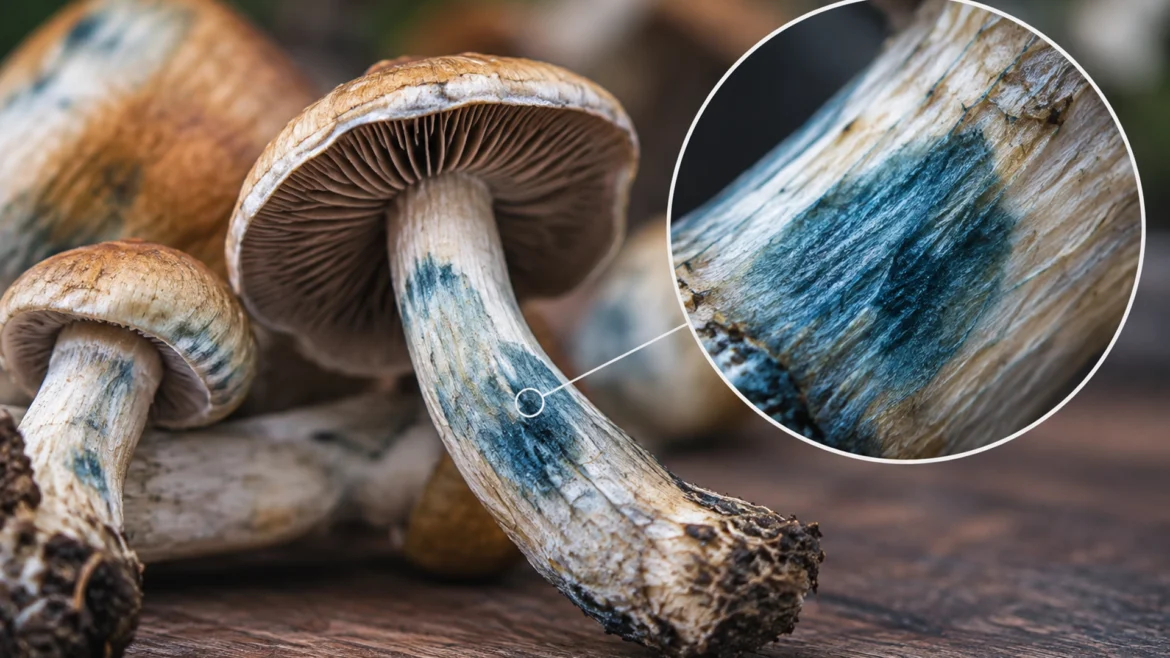
One of the most recognizable characteristics associated with many psilocybin-containing mushrooms is the appearance of blue or blue-green coloration when the mushroom tissue is bruised, cut, or otherwise damaged. This reaction has generated numerous explanations over the years, including the common belief that darker blue bruising means a mushroom contains more psilocybin.
The actual explanation is considerably more interesting.
Scientific research indicates that blue bruising results from a series of enzyme-driven chemical reactions involving psilocybin-related compounds. When mushroom tissue is damaged, psilocybin can be converted into psilocin, which then undergoes oxidation and additional chemical reactions that produce larger blue-colored compounds.
The reaction therefore provides an interesting visible example of mushroom chemistry—but it does not provide a reliable measurement of potency.
Understanding why magic mushrooms turn blue also helps clarify the differences between psilocybin and psilocin, what oxidation means, and why appearance alone cannot determine the chemical composition of a mushroom.
Why Do Magic Mushrooms Turn Blue?
Magic mushrooms can turn blue when their tissue is damaged because enzymes trigger chemical reactions involving psilocybin and psilocin. Psilocin can undergo oxidation and form larger blue-colored compounds called oligomers. Although this reaction is associated with psilocybin-containing mushrooms, the amount of blue bruising does not reliably indicate mushroom potency.
Bruising may appear after a mushroom is:
- Handled
- Pressed
- Cut
- Broken
- Damaged during harvesting
- Physically stressed
The discoloration may develop relatively quickly or become more visible over time.
What Does “Bruising” Mean?
Bruising in mushrooms is somewhat different from bruising in human skin.
When human tissue bruises, damaged blood vessels release blood beneath the skin. Mushrooms do not have blood vessels or bruise through the same biological mechanism.
Instead, what we call mushroom bruising is a chemical color change within damaged tissue.
Physical damage allows compounds and enzymes that were previously separated within cells to interact, initiating reactions that can produce visible discoloration.
What Does “Bruising” Mean?
Bruising in mushrooms is somewhat different from bruising in human skin.
When human tissue bruises, damaged blood vessels release blood beneath the skin. Mushrooms do not have blood vessels or bruise through the same biological mechanism.
Instead, what we call mushroom bruising is a chemical color change within damaged tissue.
Physical damage allows compounds and enzymes that were previously separated within cells to interact, initiating reactions that can produce visible discoloration.
Why Is the Color Blue?
For many years, scientists knew that psilocybin-containing mushrooms frequently turned blue when damaged, but the exact chemistry behind the coloration was not completely understood.
Research published in Angewandte Chemie helped characterize the process. The blue color appears to result from oligomeric compounds formed through reactions involving oxidized psilocin.
An oligomer is a molecule formed when several smaller molecular units join together.
These resulting compounds absorb and reflect light differently from their original molecules, producing the characteristic blue coloration visible in damaged mushroom tissue.
Does Psilocybin Itself Turn Blue?
Not exactly.
The process involves several chemical steps rather than psilocybin simply changing color.
In simplified form:
Tissue damage → enzymatic activity → psilocybin-related reactions → psilocin oxidation → blue-colored oligomers
That distinction is important because statements such as “psilocybin turns blue when exposed to air” oversimplify what is actually occurring.
The mushroom’s enzymes play an important role in the reaction.
Is Blue Bruising Proof That a Mushroom Contains Psilocybin?
No.
Although blue bruising is commonly associated with many psilocybin-containing mushrooms, blue coloration by itself cannot reliably identify a mushroom as psychedelic.
Other mushroom species can develop blue, green, brown, red, or other discoloration when damaged because of completely different chemical reactions.
Mushroom identification requires evaluation of multiple characteristics, and visual bruising should never be treated as definitive proof of chemical composition or species identity.
Key Point to Understand
Magic mushrooms turn blue because physical damage triggers enzyme-driven chemical reactions involving psilocybin-related compounds and the oxidation of psilocin. These reactions produce blue-colored oligomeric compounds within the damaged mushroom tissue.
The reaction is scientifically interesting, but the darkness or intensity of blue bruising does not provide a reliable measurement of psilocybin content or potency.
What Causes Blue Bruising in Magic Mushrooms?
Blue bruising begins when mushroom tissue is physically damaged. Cutting, pressing, breaking, or otherwise disrupting the tissue damages fungal cells and allows compounds and enzymes that were previously compartmentalized within the mushroom to interact.
This initiates a series of chemical reactions involving psilocybin, psilocin, and naturally occurring mushroom enzymes. The blue color is therefore not simply a stain or pigment released from inside the mushroom—it is produced through chemistry that occurs after the tissue is damaged.
What Happens When Mushroom Cells Are Damaged?
An intact mushroom maintains organization within its cells. Different compounds and enzymes may be separated within cellular structures, limiting their ability to react with one another.
When the tissue is damaged, those barriers are disrupted.
Researchers studying the blueing reaction have identified an enzymatic sequence in which psilocybin-related compounds undergo chemical transformations after cellular damage.
In simplified terms:
Cell damage → enzymes become involved → psilocybin-related compounds are transformed → oxidation occurs → blue compounds form
This explains why coloration is often concentrated around areas that have been handled, cut, crushed, or otherwise damaged.
The Role of PsiP
One enzyme associated with this process is a phosphatase known as PsiP.
A phosphatase removes phosphate groups from molecules. In the blueing reaction, PsiP can contribute to the removal of psilocybin’s phosphate group, producing psilocin.
This is chemically similar to the dephosphorylation process discussed in our article on the differences between psilocybin and psilocin.
Psilocin then becomes available for the next stage of the reaction.
The Role of PsiL
Researchers have also identified an enzyme called PsiL, a laccase involved in oxidation.
After psilocin is produced, PsiL can facilitate oxidative reactions that generate highly reactive intermediate molecules. These intermediates can subsequently combine into larger structures.
These larger structures ultimately contribute to the characteristic blue coloration.
The simplified pathway becomes:
Psilocybin → Psilocin → Oxidation → Oligomer formation → Blue coloration
What Are Oligomers?
An oligomer is a molecule composed of several smaller molecular units joined together.
In the case of blue-bruising psilocybin mushrooms, oxidation products derived from psilocin can link together to form oligomeric structures.
Researchers have identified mixtures of these compounds rather than a single simple “blue pigment.”
Their molecular structures interact with visible light in ways that produce the blue coloration observed in damaged tissue.
This is why describing the reaction as simply “psilocybin oxidizing blue” misses several important steps.
Why Doesn’t an Intact Mushroom Turn Completely Blue?
If psilocybin and psilocin are already present in mushroom tissue, it might seem reasonable to ask why the entire mushroom isn’t naturally blue.
The answer lies partly in cellular organization and enzyme control.
When cells remain intact, the molecules involved in the blueing reaction do not necessarily interact in the same way they do after tissue damage. Physical disruption creates conditions that allow the enzymatic reaction sequence to proceed more readily.
This is why bruising generally develops most visibly at damaged locations.
Is Oxygen Involved?
Oxidation is an important part of the blueing process, but describing the reaction as simply “exposure to oxygen” is incomplete.
The reaction involves enzymes and multiple chemical transformations rather than atmospheric oxygen acting alone on intact psilocybin.
That distinction helps explain why the physical damage to mushroom tissue is so important.
Does Bruising Destroy Psilocybin?
The blueing reaction involves transformations of some psilocybin-related compounds, but visible bruising does not tell us precisely how much active compound has been transformed or remains in the mushroom.
A heavily bruised area therefore cannot be used to calculate potency loss.
Similarly, a mushroom showing little visible bruising should not automatically be assumed to contain less psilocybin.
Accurately determining active-compound concentrations requires chemical analysis, not visual inspection.
Key Point to Understand
Blue bruising begins when physical damage disrupts mushroom cells and allows enzymes and psilocybin-related compounds to interact. The phosphatase PsiP can contribute to the conversion of psilocybin into psilocin, while the laccase PsiL participates in oxidation reactions involving psilocin.
The resulting compounds can combine into blue-colored oligomers, producing the characteristic discoloration seen in damaged mushroom tissue.
The Chemistry Behind the Blueing Reaction
The blue coloration of damaged psilocybin-containing mushrooms puzzled researchers for decades. Scientists understood that bruising was associated with psilocybin-related chemistry, but identifying the actual substances responsible for the color proved difficult.
Modern chemical analysis has provided a much clearer explanation. Rather than discovering one simple blue pigment, researchers found that the coloration involves a mixture of related oligomeric compounds formed from oxidized psilocin.
This discovery helps explain both the unusual color and why earlier attempts to identify a single “blue compound” were unsuccessful.
From Psilocybin to Psilocin
The first important chemical transformation involves the relationship between psilocybin and psilocin.
Psilocybin contains a phosphate group. When mushroom tissue is damaged, enzymatic activity can remove that group through dephosphorylation, producing psilocin.
In simplified form:
Psilocybin → dephosphorylation → Psilocin
Psilocin is chemically more reactive than psilocybin and becomes central to the next stage of the blueing reaction.
Psilocin Undergoes Oxidation
Once available within damaged tissue, psilocin can undergo enzyme-mediated oxidation.
Oxidation involves changes in the way electrons are distributed within a molecule. In this case, the reaction produces highly reactive intermediate compounds that can subsequently interact with one another.
Rather than remaining as isolated molecules, these oxidation products can begin joining together.
Formation of Blue Oligomers
The oxidized molecules can couple together into larger structures known as oligomers.
Researchers have identified several related oligomeric compounds containing linked psilocin-derived units. The result is not one uniform blue molecule but a mixture of chemically related structures.
This is an important distinction:
The mushroom does not simply produce a single blue pigment when bruised.
Instead, damaged tissue initiates a chemical reaction that creates a collection of compounds capable of producing the observed coloration.
Why Do These Compounds Look Blue?
Color occurs because molecules interact with visible light.
The molecular structures created during the blueing reaction contain extended systems of connected electrons. These structures can absorb certain wavelengths of visible light while allowing others to be reflected or transmitted.
The combination of wavelengths reaching our eyes is perceived as blue or blue-green coloration.
This means the visible color is a direct consequence of changes in molecular structure occurring within the damaged tissue.
Why Can the Color Vary?
Blue bruising does not always appear as exactly the same shade.
Depending on the mushroom and the progression of the chemical reactions, discoloration may appear:
- Light blue
- Dark blue
- Blue-green
- Gray-blue
- Nearly black in heavily discolored areas
Differences in tissue chemistry, concentration of reaction products, oxidation, lighting, moisture, and the physical condition of the mushroom may all influence how the coloration appears.
Color variation should therefore not be interpreted as a precise chemical measurement.
Why Was the Blueing Reaction Difficult to Explain?
One reason the phenomenon remained poorly understood for so long is that the compounds responsible for the coloration can be chemically reactive and difficult to isolate.
Researchers were not simply looking for a stable blue pigment sitting inside an intact mushroom. The colored compounds are formed through reactions initiated after tissue damage.
Modern analytical techniques allowed researchers to characterize these reaction products in greater detail and determine that oligomerized psilocin derivatives were responsible for the blue coloration.
Does the Blue Color Have a Biological Purpose?
Scientists have proposed possibilities for why psilocybin-producing mushrooms possess this enzymatic reaction system, but its biological role is not completely established.
One hypothesis is that the reaction could be associated with a defensive response to tissue damage, potentially producing compounds that discourage organisms from continuing to consume damaged mushroom tissue.
However, identifying the chemistry of the reaction does not automatically establish its evolutionary purpose. Additional research is needed before firm conclusions can be drawn.
Key Point to Understand
The blue coloration of bruised magic mushrooms results from a multi-step chemical reaction involving psilocybin, psilocin, oxidation, and oligomer formation.
When tissue is damaged, enzymatic reactions can convert psilocybin into psilocin. Psilocin-derived molecules are then oxidized and coupled together into larger oligomeric structures whose interaction with visible light produces the characteristic blue coloration.
The blue color is therefore a reaction product—not a direct visual measurement of how much psilocybin the mushroom contains.
Does Blue Bruising Mean Stronger Magic Mushrooms?
One of the most persistent beliefs about psilocybin-containing mushrooms is that the more intensely a mushroom turns blue, the more potent it must be. The idea seems reasonable because the blueing reaction involves psilocybin-related compounds.
However, the conclusion does not follow from the chemistry.
Blue bruising is not a reliable measurement of psilocybin or psilocin concentration. The color demonstrates that chemical reactions have occurred within damaged tissue, but it does not reveal how much active compound was originally present or how much remains.
Why the Potency Myth Seems Plausible
The misconception likely developed because many well-known psilocybin-containing mushroom species display blue bruising when damaged.
Scientists now know that the reaction involves psilocybin-related chemistry, including the formation and oxidation of psilocin-derived compounds.
It is therefore tempting to reason:
More psilocybin → more blueing → greater potency
But the reaction involves several additional variables, making that relationship too simplistic.
What Determines How Blue a Mushroom Becomes?
Visible coloration can be influenced by more than the starting concentration of active compounds.
Potential variables include:
- Degree of tissue damage
- Enzymatic activity
- Oxidation
- Moisture
- Tissue condition
- Concentration of reaction products
- Time since damage occurred
- Environmental conditions
- Lighting and visual perception
A mushroom experiencing extensive physical damage may therefore develop substantial discoloration without that color providing a quantitative measure of its chemical content.
What Actually Determines Mushroom Potency?
Potency depends primarily on the concentration of pharmacologically active compounds within the mushroom material.
Relevant compounds can include:
- Psilocybin
- Psilocin
- Related naturally occurring tryptamines
Their concentrations may vary according to species, genetics, individual specimens, maturity, growing conditions, drying, handling, and storage.
This natural variability means two mushrooms of similar appearance or weight may not have identical chemical profiles.
Can Two Mushrooms Bruise Differently and Have Similar Potency?
Yes.
Because bruising depends on the chemical reaction occurring after tissue damage, two mushrooms with similar active-compound concentrations could potentially display different amounts of visible discoloration.
The reverse is also possible: mushrooms displaying similar blue coloration may have different concentrations of active compounds.
Color therefore cannot substitute for chemical measurement.
Can Blue Bruising Estimate Dosage?
No.
Blue coloration does not provide enough information to determine the concentration of psilocybin or psilocin, so it cannot reliably be used to estimate dosage.
The same limitation applies to other visual characteristics such as:
- Mushroom size
- Cap color
- Stem thickness
- Degree of bruising
- Strain or cultivated-variety name
These characteristics are not standardized measurements of active-compound content.
How Is Potency Actually Measured?
Accurate potency measurement requires laboratory chemical analysis.
Analytical techniques can separate and quantify compounds such as psilocybin and psilocin within a sample. This produces measurable chemical concentrations rather than estimates based on appearance.
That distinction is particularly important when comparing whole mushrooms with controlled research involving standardized psilocybin, where researchers can work with precisely measured quantities.
Does No Blue Bruising Mean a Mushroom Contains No Psilocybin?
Not necessarily.
The absence of obvious blue bruising should not automatically be interpreted as evidence that a mushroom contains no psilocybin.
Bruising behavior can vary, and visual observation alone cannot establish chemical composition.
More importantly, blue bruising should not be used as a mushroom identification test, because other mushroom species can undergo color changes for unrelated chemical reasons.
Key Point to Understand
Blue bruising does not reliably indicate how strong a magic mushroom is. The reaction involves psilocybin-related chemistry, but the amount of visible blue coloration depends on multiple factors beyond active-compound concentration.
Determining psilocybin or psilocin content requires chemical analysis. Darker blue does not automatically mean greater potency, and little or no visible blueing does not provide a reliable measure of chemical content.
Blue Bruising vs. Contamination
Blue, green, gray, or dark discoloration on mushroom tissue can sometimes be confusing. Because psilocybin-containing mushrooms may naturally develop blue coloration after physical damage, people sometimes assume that any unusual color is simply bruising.
That assumption can be risky.
Bruising is a chemical reaction occurring within mushroom tissue, while contamination involves unwanted microorganisms such as molds or bacteria growing on or within the material. Although they are fundamentally different processes, appearance alone may not always be enough to distinguish them reliably.
What Does Normal Blue Bruising Look Like?
Blue bruising typically develops within tissue that has been physically damaged.
It may occur around areas that have been:
- Pressed or handled
- Cut
- Broken
- Crushed
- Otherwise physically damaged
Because the coloration results from chemical changes within the mushroom itself, bruising generally appears to be part of the tissue rather than a separate substance growing on its surface.
As discussed earlier, the color may range from light blue to darker blue, blue-green, or gray-blue.
However, appearance alone should not be considered a definitive identification method.
How Is Contamination Different?
Contamination is biological rather than simply chemical.
Molds, bacteria, and other microorganisms can colonize organic material under suitable environmental conditions. Depending on the organism and circumstances, contamination may cause changes in:
- Color
- Texture
- Surface appearance
- Odor
- Tissue integrity
Some molds can also produce blue-green or green coloration, which is one reason color alone cannot reliably distinguish bruising from contamination.
Bruising Does Not Grow
One useful conceptual difference is that bruising is the result of a chemical reaction in damaged tissue.
It is not a living organism.
Mold, by contrast, consists of fungal growth that can expand as the organism colonizes additional material.
That distinction is biologically important, but determining what a particular patch of discoloration represents from appearance alone may still be difficult.
What About Texture?
Bruising generally represents a change in the color of existing mushroom tissue rather than the development of a new surface layer.
Microbial contamination can sometimes produce visible changes in surface texture or tissue consistency.
However, texture is not a perfect diagnostic tool either. Different microorganisms can appear differently, and mushroom tissue itself changes as it ages or deteriorates.
For that reason, neither color nor texture should be treated as a universal safety test.
Can Smell Identify Contamination?
Unusual odors can sometimes accompany microbial spoilage, but smell is also not a reliable way to prove that mushroom material is uncontaminated.
Some microorganisms may be present without producing an obvious odor, while natural mushroom aromas can change during aging and storage.
The absence of a bad smell therefore does not establish that material is safe.
Blue-Green Does Not Automatically Mean Mold
This is an important misconception.
Because some molds can appear green or blue-green, people may assume that any blue-green discoloration indicates contamination. Conversely, someone familiar with mushroom bruising may dismiss suspicious discoloration as normal oxidation.
Neither approach is reliable.
Color must be interpreted cautiously because bruising and microbial growth can sometimes occupy overlapping portions of the visible color spectrum.
When There Is Uncertainty
If mushroom material shows unexplained discoloration, unusual growth, deterioration, or other signs that raise concerns about contamination, visual inspection through a photograph or color comparison cannot guarantee that it is safe.
Consuming spoiled or contaminated material can present risks unrelated to psilocybin itself.
When contamination cannot be confidently ruled out, the safest approach is not to consume questionable material.
Key Point to Understand
Blue bruising and contamination are different processes. Bruising results from chemical reactions within damaged mushroom tissue, while contamination involves the growth of unwanted microorganisms.
Blue coloration can be consistent with bruising, but color alone cannot prove that material is uncontaminated or safe.
Do Fresh and Dried Magic Mushrooms Bruise Differently?
Fresh and dried psilocybin-containing mushrooms can show blue discoloration differently because drying changes the mushroom’s moisture content, cellular structure, and chemical environment.
Blue bruising is generally easiest to observe in fresh mushroom tissue, where cells still contain substantial moisture and physical damage can readily initiate the enzymatic reactions responsible for the color change.
Once mushrooms have been dried, those conditions change significantly.
Why Is Bruising More Noticeable in Fresh Mushrooms?
Fresh mushroom tissue contains a large amount of water and retains much of its original cellular structure and enzymatic activity.
When that tissue is damaged, cellular compartments can rupture, allowing enzymes and psilocybin-related compounds to interact.
As discussed earlier, this can initiate the sequence involving:
Tissue damage → enzymatic activity → psilocin oxidation → blue oligomer formation
Because the mushroom is still hydrated, these reactions can occur within visibly damaged tissue and produce noticeable blue coloration.
What Changes During Drying?
Drying removes much of the water from mushroom tissue.
As moisture decreases, cellular structures change and biological processes slow dramatically. Enzyme activity also depends heavily on environmental conditions, including the availability of water.
A dried mushroom therefore does not necessarily respond to new physical damage in exactly the same way as fresh tissue.
However, discoloration that developed before or during drying may remain visible afterward.
Can Mushrooms Turn Blue While Drying?
Blue coloration can develop when tissue is damaged during handling or processing before the mushroom becomes fully dry.
For example, physical pressure or other tissue damage can initiate the blueing chemistry while sufficient moisture and enzymatic activity remain.
The resulting discoloration may then remain visible in the dried material.
This does not mean that drying itself necessarily creates blue coloration. Rather, chemical reactions associated with tissue damage may occur during the period in which the mushroom is losing moisture.
Does Blue Color Mean a Dried Mushroom Has Lost Potency?
Not necessarily.
Visible blueing indicates that some chemical reactions involving psilocybin-related compounds have occurred, but it does not reveal the overall chemical composition of the remaining mushroom.
A blue area cannot tell us:
- How much psilocybin was originally present
- How much psilocin participated in the reaction
- How much remains
- How much degradation has occurred elsewhere
- The overall potency of the mushroom
Once again, visible color is not a quantitative chemical measurement.
Drying and Chemical Stability Are Different From Bruising
It is useful to separate bruising from the broader issue of chemical degradation.
Bruising is a localized reaction associated with tissue damage.
Long-term chemical stability, on the other hand, can be affected by environmental conditions such as moisture, oxygen, heat, light, and storage time.
Psilocin is generally less chemically stable than psilocybin and is particularly susceptible to oxidation. This is one reason storage conditions can influence the chemical composition of mushroom material over time.
Our discussion of shelf life, storage, and potency examines those longer-term factors in greater detail.
Does More Blueing During Drying Mean Greater Potency?
No.
The intensity of blue coloration during or after drying still does not provide a standardized measure of active-compound concentration.
Two specimens can differ in:
- Initial chemistry
- Degree of tissue damage
- Moisture
- Enzyme activity
- Drying conditions
- Oxidation
- Storage history
Those variables prevent visible blueing from functioning as a reliable potency scale.
Can Old Mushrooms Become Blue From Age Alone?
Age-related deterioration and blue bruising should not automatically be treated as the same process.
Stored mushroom material may undergo changes in color, texture, aroma, and chemical composition over time. Those changes can result from several processes, including oxidation and general degradation.
A change in color during storage therefore does not necessarily represent the same controlled sequence responsible for classic blue bruising after fresh tissue damage.
Key Point to Understand
Fresh mushrooms generally display bruising more readily because hydrated tissue supports the enzymatic reactions responsible for blue coloration. Drying changes moisture levels, cellular structure, and enzyme activity, although bruising that develops before or during drying can remain visible afterward.
Most importantly, blue coloration in either fresh or dried mushrooms does not provide a reliable measurement of potency, freshness, or chemical stability.
Can Blue Bruising Be Used to Identify Magic Mushrooms?
Blue bruising is strongly associated with many psilocybin-containing mushrooms, which has led to a common assumption: if a mushroom turns blue when damaged, it must contain psilocybin.
That conclusion is not reliable.
Blue bruising alone cannot confirm that a mushroom contains psilocybin or identify a mushroom species. Different fungi can undergo color changes after being cut, handled, or damaged, and those reactions may involve completely different compounds.
Do All Psilocybin-Containing Mushrooms Bruise Blue?
No.
The tendency to develop visible blue coloration can vary between species and individual specimens. The intensity of the reaction may also depend on tissue chemistry, physical damage, moisture, enzymatic activity, and environmental conditions.
Some psilocybin-containing mushrooms may show obvious blueing, while others may display relatively little visible discoloration.
Therefore:
No visible blueing ≠ proof that psilocybin is absent
Just as importantly:
Visible blueing ≠ proof that psilocybin is present
Can Non-Psilocybin Mushrooms Turn Blue?
Yes.
Color-changing reactions occur throughout the fungal kingdom. Some mushrooms develop blue, green, red, yellow, brown, or black discoloration when their tissues are cut or damaged.
These reactions can result from entirely different pigments, enzymes, and chemical compounds.
For example, some bolete mushrooms are well known for rapidly developing blue coloration after their flesh is cut or bruised, despite the reaction having nothing to do with psilocybin.
This illustrates why blue coloration is a characteristic, not a chemical identification test.
Why Isn’t Bruising Enough for Mushroom Identification?
Mushroom identification typically involves evaluating multiple characteristics rather than relying on one visual feature.
Depending on the species, relevant characteristics may include:
- Cap structure and coloration
- Gill or pore structure
- Stem characteristics
- Spore characteristics
- Habitat
- Substrate
- Geographic distribution
- Microscopic features
- Other taxonomic characteristics
Even combinations of visible characteristics can sometimes be misleading because unrelated mushroom species may resemble one another.
Can Photographs Reliably Confirm a Mushroom’s Identity?
Photographs can provide useful information, but they may not capture all of the characteristics needed for confident identification.
Lighting can alter perceived colors, while camera processing can make blue, green, gray, and brown tones appear different from how they look in person.
A photograph also cannot directly reveal chemical composition.
This is particularly important when identification has safety implications.
Does Blue Bruising Prove a Mushroom Is Safe?
No.
Even if a mushroom displays coloration that resembles the blueing reaction associated with psilocybin-containing species, that does not establish that the mushroom is safe to consume.
Misidentifying wild mushrooms can have serious consequences because some species contain harmful or potentially life-threatening toxins.
A single feature such as bruising should therefore never be used as a safety test.
Identification and Potency Are Separate Questions
It is also important to distinguish two different claims:
“What species is this mushroom?”
and
“How much psilocybin does this mushroom contain?”
Blue bruising cannot reliably answer either question by itself.
Taxonomic identification determines what organism is present, while chemical analysis determines which compounds are present and at what concentrations.
Those are related areas of study, but they are not interchangeable.
Key Point to Understand
Blue bruising can be one characteristic observed in some psilocybin-containing mushrooms, but it is not proof that a mushroom contains psilocybin and should not be used as a standalone identification method.
Other mushroom species can also turn blue when damaged, while some psilocybin-containing specimens may show limited visible bruising.
Accurate mushroom identification requires consideration of multiple characteristics, and determining active-compound concentrations requires chemical analysis.
Common Myths About Blue Bruising
Blue bruising is one of the most visible characteristics associated with many psilocybin-containing mushrooms, but it is also surrounded by misconceptions. Understanding what the reaction can—and cannot—tell us helps separate observable mushroom chemistry from assumptions about potency, identification, and safety.
Myth 1: The Bluer the Mushroom, the Stronger It Is
False.
Although the blueing reaction involves psilocybin-related chemistry, the intensity of the color is influenced by multiple variables, including tissue damage, enzymatic activity, moisture, oxidation, and the concentration of reaction products.
A darker blue mushroom therefore cannot automatically be considered more potent than one showing less bruising.
Blue intensity is not a standardized measure of psilocybin concentration.
Myth 2: Any Mushroom That Turns Blue Contains Psilocybin
False.
Other mushroom species can also develop blue coloration when their tissue is damaged. These reactions may involve entirely different compounds and biochemical pathways.
Blue bruising can be a characteristic of some psilocybin-containing mushrooms, but it cannot confirm chemical composition or species identity by itself.
Myth 3: If a Mushroom Doesn’t Turn Blue, It Doesn’t Contain Psilocybin
False.
Not every psilocybin-containing mushroom displays the same degree of visible bruising.
Species, individual chemistry, tissue condition, moisture, enzyme activity, and the amount of physical damage can influence whether obvious coloration develops.
The absence of blueing therefore does not prove the absence of psilocybin.
Myth 4: Blue Bruising Means the Mushroom Is Moldy
False.
Bruising and mold are fundamentally different processes.
Blue bruising results from chemical reactions occurring within damaged mushroom tissue. Mold consists of biological growth by another fungus.
However, because microbial contamination can sometimes produce similar colors, appearance alone should not be used to determine whether questionable material is safe.
Myth 5: Blue Bruising Means All the Psilocybin Has Been Destroyed
False.
The blueing reaction involves transformations of some psilocybin-related compounds, particularly reactions involving psilocin, but visible discoloration does not reveal how much of the mushroom’s total active-compound content has changed.
A blue area therefore cannot be used to calculate potency loss.
Myth 6: Blue Bruising Is Caused Simply by Psilocybin Touching Air
Oversimplified.
Oxidation is involved, but the reaction is more complex than psilocybin simply being exposed to atmospheric oxygen.
Physical tissue damage allows enzymes and compounds within mushroom cells to interact. Psilocybin can undergo dephosphorylation, psilocin-derived compounds can be oxidized, and subsequent reactions can produce the oligomeric structures responsible for the blue coloration.
A more accurate summary is:
Tissue damage → enzymatic reactions → psilocin oxidation → oligomer formation → blue coloration
Myth 7: You Can Estimate Dosage From How Much a Mushroom Bruises
False.
Neither bruising intensity nor other visible characteristics provide a reliable measurement of active-compound concentration.
Determining concentrations of psilocybin and psilocin requires appropriate chemical analysis.
Visual appearance should therefore not be treated as a substitute for measured chemical composition.
Myth 8: Scientists Have Always Known Why Magic Mushrooms Turn Blue
False.
The blueing reaction was recognized long before researchers understood its detailed chemistry.
Modern analytical research helped establish that the coloration involves oxidized psilocin-derived oligomers, providing a much clearer explanation for a phenomenon that had remained chemically unresolved for decades.
Key Takeaway
Blue bruising tells us that a chemical reaction has occurred within damaged mushroom tissue.
It does not reliably tell us:
- How potent the mushroom is
- Exactly how much psilocybin it contains
- Whether the mushroom has been correctly identified
- Whether questionable material is safe
- How much potency may have been lost
The most important distinction is simple:
Blue bruising is an observable chemical reaction—not a potency meter, identification test, or guarantee of safety.
Frequently Asked Questions
Magic mushrooms can turn blue when physical damage triggers enzyme-driven chemical reactions involving psilocybin and psilocin. Psilocin-derived compounds undergo oxidation and can combine into larger oligomeric structures that produce the characteristic blue coloration.
No. The intensity of blue bruising is not a reliable measurement of potency. Color can be influenced by tissue damage, enzyme activity, moisture, oxidation, and other factors. Determining psilocybin and psilocin concentrations requires chemical analysis.
Not by itself. The process is more complex than psilocybin simply contacting oxygen. Tissue damage initiates enzymatic reactions that can convert psilocybin into psilocin, followed by oxidation and the formation of blue-colored oligomeric compounds.
The blue color does not appear to come from one simple pigment. Research indicates that it results from oligomeric compounds formed through reactions involving oxidized psilocin-derived molecules.
Psilocin plays an important role in the reaction. After psilocybin undergoes dephosphorylation, psilocin-derived molecules can be oxidized and subsequently form the oligomeric compounds associated with blue coloration.
No. The amount of visible blueing can vary between species and individual specimens and can be influenced by physical damage, moisture, tissue chemistry, and enzymatic activity. A lack of obvious blue bruising does not prove that psilocybin is absent.
Yes. Some mushrooms that do not contain psilocybin can also develop blue coloration when damaged. Different species can undergo completely different chemical reactions that produce similar-looking colors.
No. Blue bruising should not be used as a standalone mushroom identification method. Other mushrooms can turn blue, and identification requires consideration of multiple characteristics. Some toxic mushrooms can also be mistaken for other species, making visual assumptions potentially dangerous.
No. Bruising is a chemical change occurring within damaged mushroom tissue, while mold is microbial growth. However, color alone may not always reliably distinguish bruising from contamination.
The blueing reaction involves transformations of some psilocybin-related compounds, but visible bruising does not reveal how much active-compound content has changed. The amount of blue coloration therefore cannot be used to calculate potency loss.
Fresh mushrooms contain considerably more moisture and retain cellular conditions that support enzymatic reactions. Drying changes cellular structure, moisture levels, and enzyme activity, although discoloration that develops before or during drying can remain visible afterward.
No. Mushroom size, cap color, stem thickness, strain name, and degree of blue bruising cannot reliably determine active-compound concentration. Chemical analysis is required to accurately measure psilocybin and psilocin levels.
Understanding Why Magic Mushrooms Turn Blue
The blue bruising seen in many psilocybin-containing mushrooms is more than a simple change in appearance. It is the visible result of a series of chemical reactions triggered when mushroom tissue is damaged.
Research has helped clarify the process. Physical damage disrupts mushroom cells, allowing enzymes and psilocybin-related compounds to interact. Psilocybin can undergo dephosphorylation to form psilocin, while subsequent oxidation reactions involving psilocin-derived molecules can produce larger oligomeric compounds responsible for the characteristic blue coloration.
In simplified form:
Tissue damage → enzymatic activity → psilocin → oxidation → oligomer formation → blue coloration
Understanding this chemistry also helps correct one of the most persistent misconceptions surrounding magic mushrooms: darker blue bruising does not necessarily mean greater potency. The intensity of discoloration can be affected by tissue damage, moisture, enzymatic activity, oxidation, and other variables. Visual appearance cannot accurately reveal how much psilocybin or psilocin a mushroom contains.
Blueing also should not be treated as a definitive identification test. Other mushroom species can undergo unrelated chemical reactions that produce blue coloration, while some psilocybin-containing specimens may display relatively little visible bruising. Likewise, blue coloration alone cannot determine whether mushroom material is free from contamination.
Freshness, drying, handling, and storage conditions can further influence mushroom chemistry over time. Psilocin is generally more susceptible to oxidation and degradation than psilocybin, making it important to distinguish the immediate blueing reaction caused by tissue damage from the broader processes involved in shelf life, storage, and potency.
Scientists continue to investigate the chemistry and biological function of these compounds, but the central explanation for blue bruising is now much clearer:
Magic mushrooms turn blue because damage initiates enzyme-driven reactions involving psilocybin and psilocin that ultimately produce blue-colored oxidation products. The reaction is chemically informative, but it is not a reliable potency meter, identification test, or guarantee of safety.
Understanding the differences between psilocybin and psilocin, how mushroom chemistry varies among species, and how environmental conditions affect active compounds provides a much more accurate picture than relying on color alone.


